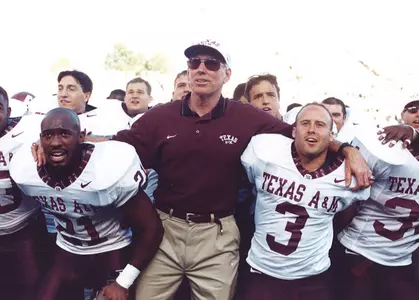
R.C. Slocum to Receive 2014 Amos Alonzo Stagg Award
Nov 20, 2013 | Football
WACO, Texas — Former Texas A&M University head coach R.C. Slocum has been named the 2014 recipient of the AFCA's Amos Alonzo Stagg Award. The award, which honors those “whose services have been outstanding in the advancement of the best interests of football,” will be presented to Slocum at the AFCA Awards Luncheon on January 14 during the 2014 AFCA Convention in Indianapolis, Indiana.
Previous honorees with Texas A&M connections include legendary coaches D.X. Bible, Paul “Bear” Bryant as well as longtime Cotton Bowl executive director and 1930 Aggie graduate Field Scovell.
Slocum retired following the 2002 season with an impressive record of 123-47-2 over the course of 14 years at Texas A&M, making him the winningest coach in Texas A&M's history. He also had assistant coaching stints at Kansas State and USC, as well. No team at Texas A&M that Slocum led ever experienced a losing season, and the Aggies won three bowl games in that time. Texas A&M made it to 10 bowl games under Slocum and won the Southwest Conference title three times and the Big 12 title once to go along with two Big 12 South titles.
“I'm so honored because of what the name 'Amos Alonzo Stagg' has meant to the coaching profession,” said Slocum. “It's humbling to be recognized with all the great coaches who have won the award before me.”
Born on November 7, 1944, Slocum was born in Oakdale, La., and grew up in Orange, Texas, where he was an All-District player at Stark High School. Slocum went on to play at McNeese State in Lake Charles, La., as a tight end and defensive lineman. While there, he set receiving records and was a four-year letterman as a Cowboy. After receiving his undergraduate degree and master's in Education Administration, Slocum went on to coach at Lake Charles (La.) High School in 1968 and 1969. From there, he moved onto Kansas State University, where he was an assistant for the 1970-1971 seasons under Vince Gibson. It was in 1972 when Slocum found himself at the university that would define his career. Under Emory Bellard, and later Tom Wilson, Slocum worked at a variety of positions at Texas A&M, starting as a receivers coach before being moved to the other side of the ball as a defensive ends coach. After a brief stint as the linebackers coach for the Aggies, Slocum was the defensive coordinator for the 1979-1980 seasons. In 1981, he was hired on as defensive coordinator at USC, where his defense led the Pac-10. After his one season with the Trojans, Slocum returned to Texas A&M as the defensive coordinator from 1982-1988 under Jackie Sherrill. Slocum was named head coach of the Aggies in 1989, where he quickly had the team firing on all cylinders.
With Slocum at the reins, the Texas A&M Aggies enjoyed some of their most successful seasons in decades, culminating in three straight Southwest Conference titles in 1991 through 1993. It was Slocum's famous “Wrecking Crew” defense that led the way for the Aggies through this time, leading the Southwest Conference in four defensive statistical categories and led the nation in total defense in 1991. To go along with the three straight conference titles, Slocum's Aggies also had one of the greatest league winning streaks, winning 22 straight games and going 28-0-1 from 1991-94. After guiding the Aggies through the transition period between the Southwest Conference and the newly created Big 12 Conference, Slocum racked up one last conference championship, defeating the top-ranked and favored undefeated Kansas State Wildcats in 1998 and obtaining the conference's Sugar Bowl berth. Slocum stepped down from coaching after the 2002 season and immediately stepped into the role of an advisor for the university that he had put so much into.
Players under Slocum achieved plenty of success in their college careers, as 14 players earned First Team All-America honors, including Bednarik and Lombardi Award winning linebacker Dat Nguyen in 1998.
He helped even more players find success at the next level, as 50 different Aggies moved on from their time at College Station to play in professional leagues.
Upon Slocum's retirement, he has worked as a special advisor and assistant to Texas A&M's presidents, most recently R. Bowen Loftin.
Since retiring from coaching, Slocum has done a multitude of charitable work, serving as the chairman of two organizations: the Children's Miracle Network in Central Texas and the Cattle Barron's Association, which raises scholarship money for young people in ranching. He has also helped with other organizations, such as the Peaceable Kingdom Retreat for Children, the Houston Live Stock Show and Rodeo and the Special Olympics.
Slocum spent time as a Trustee for the American Football Coaches Association and currently serves as President for the American Football Coaches Foundation. He has been inducted into several Halls of Fame, including the Texas Sports Hall of Fame in 2006, the Texas A&M University Athletics Hall of Fame and, most recently, the College Football Hall of Fame in 2012.
The Award
The Amos Alonzo Stagg Award is given to the “individual, group or institution whose services have been outstanding in the advancement of the best interests of football.” Its purpose is “to perpetuate the example and influence of Amos Alonzo Stagg.”
The award is named in honor of a man who was instrumental in founding the AFCA in the 1920s. He is considered one of the great innovators and motivating forces in the early development of the game of football. The plaque given to each recipient is a replica of the one given to Stagg at the 1939 AFCA Convention in tribute to his 50 years of service to football.
Amos Alonzo Stagg
Amos Alonzo Stagg began his coaching career at the School of Christian Workers, now Springfield (Mass.) College, after graduating from Yale University in 1888.
Stagg also served as head coach at Chicago (1892-1932) and College of the Pacific (1933-1946). His 41 seasons at Chicago is one of the longest head coaching tenures in the history of the college game.
Among the innovations credited to Stagg are the tackling dummy, the huddle, the reverse play, man in motion, knit pants, numbering plays and players, and the awarding of letters.
A long-time AFCA member, Stagg was the Association's 1943 Coach of the Year.
According to NCAA records, Stagg's 57-year record as a college head coach is 314-199-35. He was 84 years old when he ended his coaching career at Pacific in 1946. He died in 1965 at the age of 103.
Past Amos Alonzo Stagg Award Winners
1940 Donald Herring, Jr., (Princeton player) and family
1941 William H. Cowell (posthumously), New Hampshire
1946 Grantland Rice, sportswriter
1947 William A. Alexander, Georgia Tech
1948 Gilmour Dobie, North Dakota State, Washington, Navy, Cornell, Boston College
Glenn S. “Pop” Warner, Georgia, Cornell, Carlisle, Pittsburgh, Stanford, Temple
Robert C. Zuppke, Illinois
1949 Richard C. Harlow, Penn State, Colgate, Western Maryland, Harvard
1950 No award given
1951 DeOrmond “Tuss” McLaughry, Westminster, Amherst, Brown, Dartmouth
1952 A.N. “Bo” McMillin, Indiana
1953 Lou Little, Georgetown, Columbia
1954 Dana X. Bible, Mississippi College, LSU, Texas A&M, Nebraska, Texas
1955 Joseph J. Tomlin, founder, Pop Warner Football
1956 No award given
1957 Gen. Robert R. Neyland, Tennessee
1958 Bernie Bierman, Mississippi A&M, Tulane, Minnesota
1959 Dr. John W. Wilce, Ohio State
1960 Harvey J. Harman, Haverford, University of the South, Pennsylvania, Rutgers
1961 Ray Eliot, Illinois
1962 E.E. “Tad” Wieman, Michigan, Princeton, Maine
1963 Andrew Kerr, Stanford, Washington & Jefferson, Colgate, Lebanon Valley
1964 Don Faurot, Missouri
1965 Harry Stuhldreher, Wisconsin
1966 Bernie H. Moore, LSU
1967 Jess Neely, Southwestern, Clemson, Rice
1968 Abe Martin, TCU
1969 Charles A. “Rip” Engle, Brown, Penn State
1970 Lynn “Pappy” Waldorf, Syracuse, Oklahoma City, Kansas, Oklahoma A&M, Kansas State, Northwestern, California
1971 Bill Murray, Delaware, Duke
1972 Jack Curtice, Stanford
1973 Lloyd Jordan, Amherst, Harvard
1974 Alonzo S. “Jake” Gaither, Florida A&M
1975 Gerald B. Zornow, business executive
1976 No award given
1977 Floyd “Ben” Schwartzwalder, Muhlenberg, Syracuse
1978 Tom Hamilton, Navy, Pittsburgh
1979 H.O. “Fritz” Crisler, Minnesota, Princeton, Michigan
1980 No award given
1981 Fred Russell, sportswriter
1982 Eddie Robinson, Grambling
1983 Paul W. “Bear” Bryant, Maryland, Kentucky,Texas A&M, Alabama
1984 Charles B. “Bud” Wilkinson, Oklahoma
1985 Duffy Daugherty, Michigan State
1986 Woody Hayes, Denison, Miami (Ohio), Ohio State
1987 Field Scovell, Cotton Bowl
1988 G. Herbert McCracken, Allegheny, Lafayette
1989 David Nelson, Delaware
1990 Len Casanova, Oregon
1991 Bob Blackman, Denver, Dartmouth, Illinois, Cornell
1992 Charles McClendon, LSU
1993 Keith Jackson, ABC-TV
1994 Bob Devaney, Nebraska, Wyoming
1995 John Merritt, Jackson State, Tennessee State
1996 Chuck Neinas, College Football Association
1997 Ara Parseghian, Miami (Ohio), Northwestern, Notre Dame
1998 Bob Reade, Augustana (Ill.)
1999 Bo Schembechler, Miami (Ohio), Michigan
2000 Tom Osborne, Nebraska
2001 Vince Dooley, Georgia
2002 Joe Paterno, Penn State
2003 LaVell Edwards, Brigham Young
2004 Ron Schipper, Central (Iowa)
2005 Hayden Fry, North Texas, SMU, Iowa
2006 Grant Teaff, McMurry, Angelo State, Baylor
2007 Bill Curry, Georgia Tech, Alabama, Kentucky
2008 Bill Walsh, San Francisco 49ers, Stanford
2009 John Gagliardi, Carroll (Mont.), St. John's (Minn.)
2010 Darrell Royal, Mississippi State, Washington, Texas
2011 Bobby Bowden, Samford, West Virginia, Florida State
2012 Fisher DeBerry, U.S. Air Force Academy
2013 Frosty Westering, Parsons, Lea College, Pacific Lutheran
For more information on the AFCA and its programs, log on to the AFCA's website at www.afca.com.
-(AFCA)-