


There's no prettier patch of grass in the great state of Texas than Kyle Field the day before a game.
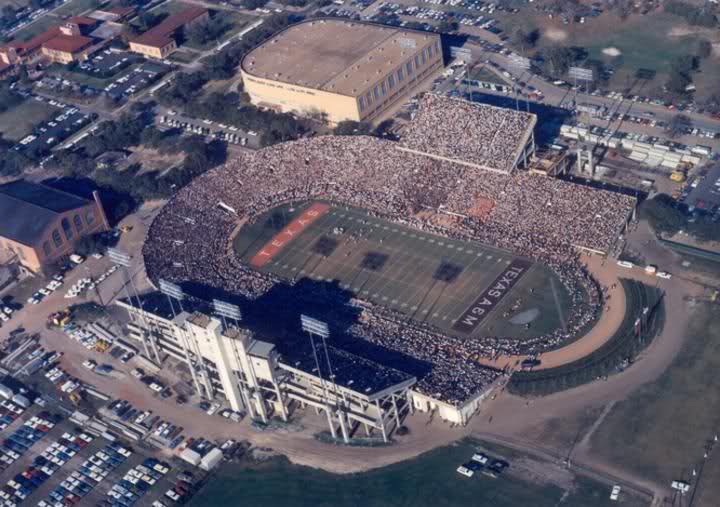
And this weekend, she'll be even more decked out than usual—displaying maroon end zones for the first time in almost 50 years.
Thanks to the hard work of the award-winning Texas A&M Athletics Field Staff, Kyle Field's playing surface will be shining like a jewel to millions around the globe under the lights of a national television broadcast.
"I have the best crew in the country," said Athletic Fields Manager Craig Potts, Class of '90.
Potts oversees a crew of five full-time workers—Nick McKenna, Jordan Vasquez, Jake Johnson and Amanda Folck—and all, along with several student workers, have a hand in making Kyle Field what it is.


"We can't do what we do without them," Potts said. "They've allowed me to move around and keep an eye on everything, because I know I can come back and the field will be the way we expect it to be as a crew.
"Each one of them takes pride in their facility."
It's not just Kyle Field that the staff oversees—they're in charge of the playing surfaces at Ellis Field, Blue Bell Park and the Aggie Softball Complex; the infield of the Anderson Track and Field Complex, the Coolidge (football) Practice Fields, and they're currently overseeing field installation at the new softball stadium going up on west campus.
In fact, just this week alone they had to prep not only Kyle Field but the practice fields, soccer twice, the cross country course and even baseball (fall practices going on).
The idea of painting the end zones was presented to the staff around the time of the first home game. It's not just as simple as throwing paint down—thought had to go in to whether they'd be able to block out the traditional end zone design, which had been painted three prior times (they for the most part can, but there's always a bit that will show through). Also thought had to be put in for whether or not the grass could grow back green with the next home game three weeks away (again, for the most part it can, but it will be dependent on weather conditions).


The TEXAS A&M in the end zone was inspired by the look of the field in 1967, while the "aTm" in the corner of the zone is an exact replica of the helmet decal worn at the time.

"We ordered the stencils, and those took about a week and a half to get in," Potts said. "And we had to order a lot more maroon paint."
That's an understatement.
The crew ended up using around 125 gallons of maroon paint, and that's just to deal with the end zones. Potts estimates that the paint job added about 16 hours of work for each end zone, essentially doubling the amount of man hours it takes to get the field painted and ready to go for a weekend.
And to Potts and his team, 'ready to go' means so much more than the paint.
"This is one of the best playing surfaces in the country," Potts said. "And in our profession, positive feedback is awesome—but we also want to be seen but not seen, if that makes sense. You know your crew is doing really well when there are zero issues with the field. That's what you want.
"Our number one goal is safety of the field. Ultimately, everything else is secondary to us."
But, when it's all said and done and the game kicks off, the crew will sit back on Saturday and look at the playing surface with a smile.
"We step back with a lot of pride," Potts said. "We have pride in what we do. Yes, this is extra work for us, but by the same token it's something the fans love to see and we are in a service industry. Our job is to serve and (do our part to) bring out the best of Texas A&M."


And this weekend, she'll be even more decked out than usual—displaying maroon end zones for the first time in almost 50 years.
Thanks to the hard work of the award-winning Texas A&M Athletics Field Staff, Kyle Field's playing surface will be shining like a jewel to millions around the globe under the lights of a national television broadcast.
"I have the best crew in the country," said Athletic Fields Manager Craig Potts, Class of '90.
Potts oversees a crew of five full-time workers—Nick McKenna, Jordan Vasquez, Jake Johnson and Amanda Folck—and all, along with several student workers, have a hand in making Kyle Field what it is.
"We can't do what we do without them," Potts said. "They've allowed me to move around and keep an eye on everything, because I know I can come back and the field will be the way we expect it to be as a crew.
"Each one of them takes pride in their facility."
It's not just Kyle Field that the staff oversees—they're in charge of the playing surfaces at Ellis Field, Blue Bell Park and the Aggie Softball Complex; the infield of the Anderson Track and Field Complex, the Coolidge (football) Practice Fields, and they're currently overseeing field installation at the new softball stadium going up on west campus.
In fact, just this week alone they had to prep not only Kyle Field but the practice fields, soccer twice, the cross country course and even baseball (fall practices going on).
The idea of painting the end zones was presented to the staff around the time of the first home game. It's not just as simple as throwing paint down—thought had to go in to whether they'd be able to block out the traditional end zone design, which had been painted three prior times (they for the most part can, but there's always a bit that will show through). Also thought had to be put in for whether or not the grass could grow back green with the next home game three weeks away (again, for the most part it can, but it will be dependent on weather conditions).
The TEXAS A&M in the end zone was inspired by the look of the field in 1967, while the "aTm" in the corner of the zone is an exact replica of the helmet decal worn at the time.
"We ordered the stencils, and those took about a week and a half to get in," Potts said. "And we had to order a lot more maroon paint."
That's an understatement.
The crew ended up using around 125 gallons of maroon paint, and that's just to deal with the end zones. Potts estimates that the paint job added about 16 hours of work for each end zone, essentially doubling the amount of man hours it takes to get the field painted and ready to go for a weekend.
And to Potts and his team, 'ready to go' means so much more than the paint.
"This is one of the best playing surfaces in the country," Potts said. "And in our profession, positive feedback is awesome—but we also want to be seen but not seen, if that makes sense. You know your crew is doing really well when there are zero issues with the field. That's what you want.
"Our number one goal is safety of the field. Ultimately, everything else is secondary to us."
But, when it's all said and done and the game kicks off, the crew will sit back on Saturday and look at the playing surface with a smile.
"We step back with a lot of pride," Potts said. "We have pride in what we do. Yes, this is extra work for us, but by the same token it's something the fans love to see and we are in a service industry. Our job is to serve and (do our part to) bring out the best of Texas A&M."