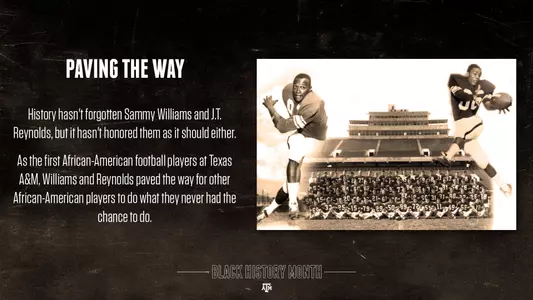
Paving the Way
Oct 23, 2018 | Football
Sammy Williams left Texas A&M, degree in hand, in 1969 with no intentions ever to return to College Station. But decades passed, wounds healed and times changed.
When Williams walked back onto campus again in 1989, he found a different Aggieland. A more diverse Aggieland. A more welcoming Aggieland.
"The pride comes in the first time I saw an African-American student wearing her senior boots," Williams said. "I got all choked up. I told her, 'I'm so proud of you.' She said, 'Why?' I said, 'Because you're getting to wear the senior boots. I never did.' I chose not to stay in the Corps."
History hasn't forgotten Williams and J.T. Reynolds, but it hasn't honored them as it should either. As the first African-American football players at A&M, Williams and Reynolds paved the way for other African-American players to do what they never had the chance to do.
Williams and Reynolds were restricted to playing special teams and only during home games despite believing they were better than some of their white teammates.

"It's the way life goes sometimes; you just move on," Reynolds, 71, said. "I was a student first. Going further to play football was not necessarily my motivation. My motivation was to be a student, get my degree and move on with my career.
"You always think about what could have been, but that doesn't do any good. All of that faded glory is long gone."
Both Williams and Reynolds had successful careers after college, setting many firsts. But their initial first came at A&M when they walked onto the football team in 1967, the first black players to make the roster.
He hoped to go to Purdue to major in engineering, but his father, Sam Williams Sr., told him the family couldn't afford it. So, Williams looked at Oklahoma State, Texas Tech and the University of Houston. He finally settled on A&M because it was "cheap" and had a strong engineering program.
Williams had no idea it was an all-military school until he arrived in 1964, the year before membership in the Corps of Cadets became voluntary in 1965.
A&M was all white until 1963 when three African-Americans enrolled in the first summer session, and a year later, five freshmen became the first African-Americans in the Corps of Cadets.
It was not easy, seeing few faces like their own and occasionally hearing racist comments.
"I got really, really down one time," Williams said. "I called my mom. I said, 'I can't take this anymore. I'm the only black person on this campus I see every day. I want to come home.' She told my dad, and they drove up. I just remember my father lecturing me about not giving up. He was a World War II vet, and he said, 'I did not walk all over Europe and fight and risk my life for this country to raise someone who would quit.' He turned to my mom and said, 'Marguerite, let's go home.' He left me on the corner with tears in my eyes. I had to kind of regroup and say, 'OK, that's not going to happen.'"
Williams decided he wanted to play football, so he showed up for freshmen practice and dressed. But he didn't even make it onto the field for his first practice. Head coach Hank Foldberg noticed Williams – it was hard not to considering Williams was the only non-white on the field – and ordered him back into the locker room.

Foldberg met with Williams the following day and told him A&M had no plans to integrate its sports teams. So, Williams joined the track team, where coach Charlie Thomas welcomed him as a quartermiler.
Academic troubles, though, sent Williams home for a semester, keeping him from ever competing for the Aggies in track. He forgot about his football dream until meeting Reynolds.
Reynolds did whatever sport was in season or whatever sport he was allowed to play.
"I was an athlete, and then to somehow encounter, 'You can't play,' whether it was politics or racism, my mother would often tell us, 'There are times you are better than others, and you still will not get the nod,'" Reynolds said, "so don't allow any of that nonsense discourage you. You just pursue and pursue and persevere.'
"Sure, I let it bother me at times, but then you pray on it, and you move on."
Reynolds' football career nearly ended his freshman season at La Marque Lincoln High when, in his second week of practice, he made a tackle on the dirt field. He didn't realize, until a coach grabbed Reynolds' arm, that he had landed on a piece of glass. Reynolds needed eight stitches to close the cut.

"I still have a huge scar on my right forearm from that," Reynolds said. "It scared me. I never wanted to practice on that field again because it was so traumatic. So I ended up being the sports writer for the high school newspaper. But I still played sandlot and neighborhood football, because you don't grow up in Texas and not play football."
Reynolds didn't follow the family path to Tuskegee, where his brother, Paul, played quarterback, and his sister, Loretta, played clarinet in the band. Instead, Reynolds, who knew exactly what he wanted to be when he grew up, chose A&M because of its wildlife science program.
Reynolds turned to Williams after an intramural football game in 1966, and said, "We need to try out for the football team. We're better than they are." Williams, who was looking for a way out of the Corps, said, "Well, I know that," in agreement.
Reynolds and Williams talked to head coach Gene Stallings, who agreed to let them participate in spring drills and conditioning. They survived the grueling, weed-out process, earning an official letter inviting them to fall practice.
They made the 1967 team, changing the face of football at A&M forever.
While Jerry Honore became the first African-American football player recruited to A&M and Hugh McElroy became the first to travel, Reynolds and Williams were the first to wear the Aggie uniform.
"Just the fact they did play broke the barrier," said Gaddy Wells, a teammate of Williams and Reynolds who graduated from A&M in 1969.
Reynolds and Williams weren't allowed to travel, because they couldn't stay at the same hotels as their white teammates. They practiced on the scout team, and although both were second-team, they never got into a home game on offense or defense.
They still don't know why.
"I went to the coaches several times to ask why," said Reynolds, a linebacker and safety. "'Whatever the reasons, I'm not moving up, and I'm just as good or better than some of the guys playing on defense. So why aren't you playing me?'
"But I had a mother who taught me many things books didn't teach us. We had all kinds of black history books. I had all that information in my head. I had my culture in my head. I understood what was going on in the world at the time."
On several occasions, Aggies defensive coordinator Dee Powell encouraged Reynolds not to quit.
Some players did quit, unable to handle the demanding practices, but Reynolds and Williams never considered it. That's why it didn't take either long to earn the respect of their teammates, who saw them only as that.
"I think we all saw it as you're respected for who you are and not what your color is," said Tommy Maxwell, an All-Southwest Conference receiver in 1967 and an All-American defensive back in 1968. "It was tough, real tough back then under Stallings. It was much harder than what the Junction Boys went through. They had it for 10 days. We had it for four years. Sammy and J.T. proved who they were by working hard and surviving that with us, so we didn't see color.
"It's still that way today. They're both very much a part of our reunions and are both great people who have accomplished a lot in life. We consider them special for stepping out."
Reynolds and Williams earned scholarships in 1968, and both were honored, along with their teammates, last year for the 50th anniversary of the 1967 team. The Aggies won the Southwest Conference title and beat Alabama in the Cotton Bowl that season.

"Today, everybody is fairly close," Williams, a receiver, said.
Reynolds, who lives in Henderson, Nevada, went on to serve as a medic in the Army. He retired in 2009 after a 40-year career with the National Park Service, where he was a chief ranger for the western U.S. until age 55, and at the time of his retirement, the superintendent of Death Valley National Park, the largest park in the federal system. He works full time at Pinecrest Academy of Nevada, coaches flag football and leads a non-profit outdoor education program.
His son, Jamol, graduated from A&M in 1999.
Williams, who lives in Houston but is in the process of moving to a Philadelphia suburb to be closer to family, had a career as a sales engineer for General Electric and other major tech companies. He retired from Emerson Electric in 2009. From 1989-93, he served on an A&M president's advisory committee for black issues, and he remains active with Caring Aggies Mentoring Program.
His daughter, Angela, graduated from A&M in 2001.
"I didn't go to A&M to be the first," Williams, 71, said. "We didn't go out for football to be the first. We wanted to play. We got tired of standing up.
"But the pride comes in seeing where the school is now."
When Williams walked back onto campus again in 1989, he found a different Aggieland. A more diverse Aggieland. A more welcoming Aggieland.
"The pride comes in the first time I saw an African-American student wearing her senior boots," Williams said. "I got all choked up. I told her, 'I'm so proud of you.' She said, 'Why?' I said, 'Because you're getting to wear the senior boots. I never did.' I chose not to stay in the Corps."
History hasn't forgotten Williams and J.T. Reynolds, but it hasn't honored them as it should either. As the first African-American football players at A&M, Williams and Reynolds paved the way for other African-American players to do what they never had the chance to do.
Williams and Reynolds were restricted to playing special teams and only during home games despite believing they were better than some of their white teammates.
"It's the way life goes sometimes; you just move on," Reynolds, 71, said. "I was a student first. Going further to play football was not necessarily my motivation. My motivation was to be a student, get my degree and move on with my career.
"You always think about what could have been, but that doesn't do any good. All of that faded glory is long gone."
Both Williams and Reynolds had successful careers after college, setting many firsts. But their initial first came at A&M when they walked onto the football team in 1967, the first black players to make the roster.
"I WANT TO COME HOME"
Williams didn't play football at Houston Wheatley. He instead swam.He hoped to go to Purdue to major in engineering, but his father, Sam Williams Sr., told him the family couldn't afford it. So, Williams looked at Oklahoma State, Texas Tech and the University of Houston. He finally settled on A&M because it was "cheap" and had a strong engineering program.
Williams had no idea it was an all-military school until he arrived in 1964, the year before membership in the Corps of Cadets became voluntary in 1965.
A&M was all white until 1963 when three African-Americans enrolled in the first summer session, and a year later, five freshmen became the first African-Americans in the Corps of Cadets.
It was not easy, seeing few faces like their own and occasionally hearing racist comments.
"I got really, really down one time," Williams said. "I called my mom. I said, 'I can't take this anymore. I'm the only black person on this campus I see every day. I want to come home.' She told my dad, and they drove up. I just remember my father lecturing me about not giving up. He was a World War II vet, and he said, 'I did not walk all over Europe and fight and risk my life for this country to raise someone who would quit.' He turned to my mom and said, 'Marguerite, let's go home.' He left me on the corner with tears in my eyes. I had to kind of regroup and say, 'OK, that's not going to happen.'"
Williams decided he wanted to play football, so he showed up for freshmen practice and dressed. But he didn't even make it onto the field for his first practice. Head coach Hank Foldberg noticed Williams – it was hard not to considering Williams was the only non-white on the field – and ordered him back into the locker room.
Foldberg met with Williams the following day and told him A&M had no plans to integrate its sports teams. So, Williams joined the track team, where coach Charlie Thomas welcomed him as a quartermiler.
Academic troubles, though, sent Williams home for a semester, keeping him from ever competing for the Aggies in track. He forgot about his football dream until meeting Reynolds.
"YOU CAN'T PLAY"
Reynolds' mother, Leatha Brown Reynolds, taught for years in La Marque public schools after earning her degree from Tuskegee Institute, where Booker T. Washington and George Washington Carver taught at the time. She also coached girls' half-court, six-on-six basketball, and when J.T. was in elementary school, he often participated in their practices, refusing to stay on his half of the court.Reynolds did whatever sport was in season or whatever sport he was allowed to play.
"I was an athlete, and then to somehow encounter, 'You can't play,' whether it was politics or racism, my mother would often tell us, 'There are times you are better than others, and you still will not get the nod,'" Reynolds said, "so don't allow any of that nonsense discourage you. You just pursue and pursue and persevere.'
"Sure, I let it bother me at times, but then you pray on it, and you move on."
Reynolds' football career nearly ended his freshman season at La Marque Lincoln High when, in his second week of practice, he made a tackle on the dirt field. He didn't realize, until a coach grabbed Reynolds' arm, that he had landed on a piece of glass. Reynolds needed eight stitches to close the cut.
"I still have a huge scar on my right forearm from that," Reynolds said. "It scared me. I never wanted to practice on that field again because it was so traumatic. So I ended up being the sports writer for the high school newspaper. But I still played sandlot and neighborhood football, because you don't grow up in Texas and not play football."
Reynolds didn't follow the family path to Tuskegee, where his brother, Paul, played quarterback, and his sister, Loretta, played clarinet in the band. Instead, Reynolds, who knew exactly what he wanted to be when he grew up, chose A&M because of its wildlife science program.
CHANGING THE FACE OF FOOTBALL
Williams met Reynolds when Reynolds enrolled as a freshman. The two became fast friends and eventually roommates.Reynolds turned to Williams after an intramural football game in 1966, and said, "We need to try out for the football team. We're better than they are." Williams, who was looking for a way out of the Corps, said, "Well, I know that," in agreement.
Reynolds and Williams talked to head coach Gene Stallings, who agreed to let them participate in spring drills and conditioning. They survived the grueling, weed-out process, earning an official letter inviting them to fall practice.
They made the 1967 team, changing the face of football at A&M forever.
While Jerry Honore became the first African-American football player recruited to A&M and Hugh McElroy became the first to travel, Reynolds and Williams were the first to wear the Aggie uniform.
"Just the fact they did play broke the barrier," said Gaddy Wells, a teammate of Williams and Reynolds who graduated from A&M in 1969.
Reynolds and Williams weren't allowed to travel, because they couldn't stay at the same hotels as their white teammates. They practiced on the scout team, and although both were second-team, they never got into a home game on offense or defense.
They still don't know why.
"I went to the coaches several times to ask why," said Reynolds, a linebacker and safety. "'Whatever the reasons, I'm not moving up, and I'm just as good or better than some of the guys playing on defense. So why aren't you playing me?'
"But I had a mother who taught me many things books didn't teach us. We had all kinds of black history books. I had all that information in my head. I had my culture in my head. I understood what was going on in the world at the time."
On several occasions, Aggies defensive coordinator Dee Powell encouraged Reynolds not to quit.
Some players did quit, unable to handle the demanding practices, but Reynolds and Williams never considered it. That's why it didn't take either long to earn the respect of their teammates, who saw them only as that.
"I think we all saw it as you're respected for who you are and not what your color is," said Tommy Maxwell, an All-Southwest Conference receiver in 1967 and an All-American defensive back in 1968. "It was tough, real tough back then under Stallings. It was much harder than what the Junction Boys went through. They had it for 10 days. We had it for four years. Sammy and J.T. proved who they were by working hard and surviving that with us, so we didn't see color.
"It's still that way today. They're both very much a part of our reunions and are both great people who have accomplished a lot in life. We consider them special for stepping out."
Reynolds and Williams earned scholarships in 1968, and both were honored, along with their teammates, last year for the 50th anniversary of the 1967 team. The Aggies won the Southwest Conference title and beat Alabama in the Cotton Bowl that season.
"Today, everybody is fairly close," Williams, a receiver, said.
Reynolds, who lives in Henderson, Nevada, went on to serve as a medic in the Army. He retired in 2009 after a 40-year career with the National Park Service, where he was a chief ranger for the western U.S. until age 55, and at the time of his retirement, the superintendent of Death Valley National Park, the largest park in the federal system. He works full time at Pinecrest Academy of Nevada, coaches flag football and leads a non-profit outdoor education program.
His son, Jamol, graduated from A&M in 1999.
Williams, who lives in Houston but is in the process of moving to a Philadelphia suburb to be closer to family, had a career as a sales engineer for General Electric and other major tech companies. He retired from Emerson Electric in 2009. From 1989-93, he served on an A&M president's advisory committee for black issues, and he remains active with Caring Aggies Mentoring Program.
His daughter, Angela, graduated from A&M in 2001.
"I didn't go to A&M to be the first," Williams, 71, said. "We didn't go out for football to be the first. We wanted to play. We got tired of standing up.
"But the pride comes in seeing where the school is now."
Monday, April 27
Saturday, April 18
Saturday, April 18
Saturday, April 18