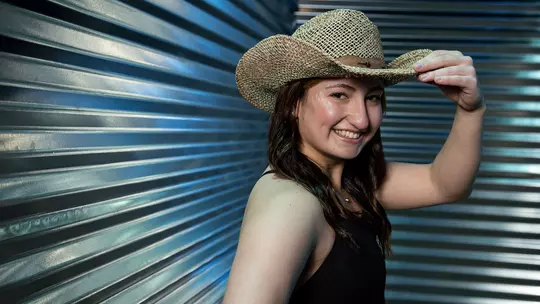
Get to Know: Alyssa Clairmont
Katy Gallaher, Athletics Communications
Alyssa Clairmont has been one of Texas A&M’s top women’s divers this season, tallying 10 first-place scores and 17 top-three scores her senior year as the team captain. She's also punched her ticket to this month's NCAA Championships in Knoxville.
The Regina, Saskatchewan, native qualified for NCAAs in three of her four seasons in Aggieland, competing in all three diving events in 2022.
Clairmont sits down to talk about her story and growth at A&M along with the impact of her teammates and coaches.
What made you choose A&M and how was the transition for you, being so far away from your home in Canada?
“I chose A&M because it was the team I thought was closest to a family, away from home. The transition was difficult for many reasons, not just school and atmosphere but financial situations and being on my own in general which is a hard transition for anyone. But I made it work with all the resources and support I had which was the main reason I came. I knew I would have that support from people.”
What are you studying and what do you plan to do with your degree after graduation?
“I'm studying psychology with a minor in sociology. As for right now, my plan is to go to grad school for developmental psychology or applied behavioral analysis, working with children. I like how children’s brains work and I’m deciding if I want to go into counseling in children's adolescence or with their families. I like working with kids because there’s an innocence in their minds that allows for more treatment instead of all the biases that can come from being an adult so that’s why I’m interested in working with kids.”
What’s it like to travel with and constantly be around such a close-knit group in the divers?
“Traveling with the dive team is my favorite part of being on this team because it’s just a different adventure every single time. We encounter new challenges and everywhere we go is fun. There’s always something to do, always something to laugh about and someone on the team is always new to the experience so it’s fun to watch others be a part of it and make those memories with us.”
What was one of your favorite places you traveled with the team this season?
“Definitely Colorado.”
How does the environment at the diving well change from the regular season to the post-season?
“In the regular season, it’s a lot of reps, a lot of time put into the pool and harder workouts in general. When we get into the post-season, it’s a lot more quality over quantity. It’s kind of the same way the swimmers taper, we do fewer reps and go for focusing on corrections and dialing in more to the detail so that we don’t burn ourselves out before competition. Practices tend to be shorter because of that. It changes day to day really and you get to personalize it for practice based on how you feel and how you’re looking.”
How were you introduced to the sport?
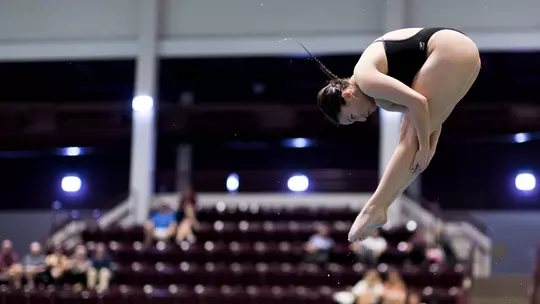
“I was introduced to the sport through a public flyer in my hometown. I used to be a gymnast and I was taking swim lessons at this pool then saw the flyer. We would always do our swim lessons next to the divers while they practiced so I got to see what it looked like. I was 10 and saw that flyer like ‘yeah, let’s do it.’ I quit gymnastics around 7 or 8 so I was looking for something to do next and diving came along.”
Tell me a little about Coach Lerew and his impact on you and other divers…
“Coach (Jay) Lerew and Wendy (Lerew) have been like my parents here in Texas. I knew Wendy before and she has connections with a lot of Canadian divers so even when I was being recruited, they told me if I were to come here, they would look after me. When my parents dropped me off, they told my parents again that they would look after me and always be there for me. No matter what it was in school, diving or just life. I always felt I had that support and even for one of my labs I put Jay as my emergency contact because he was the person I could rely on. He’s always been that for me in this sport. If I have something I need to talk about, I could always go to Jay, and if he doesn’t know what to say he just listens. I know he also does that for my teammates as well. He’s helped a lot of us through a lot of mental things we’ve needed help with, and he’s never failed to support us the way we need him to.”
Do you have specific dives that you are always excited about or anticipating?
“Yes, it’s the back two-and-a-half on the 3-meter or 10-meter. Honestly, anything backward. On the 3-meter tower, you stand backward and flip backward, and I have a rhythm with it that I just know exactly how to move my body so it’s almost the same every time. From practice to practice it’s like my go-to dive if I need to warm up with something, I’ll do that. I’ve been doing it for so long that it’s just comfortable for me.”
What would you say is the biggest mental challenge in diving?
“Having the confidence to trust your practices when you go to competition. I think that’s the hardest thing to learn as a diver and it took me a long time to do that. It took me up until last year to figure that out. So, it had been 10 years and Jay helped me realize that that’s what I needed to be the consistent performer that I am now. He taught me how to trust my practices and take them to competition. If I didn’t know how to do that then I took my competition to practice and treated practice like a meet and that’s where my confidence came from.”
Before or after meets, do you have any specific rituals or traditions with the team?
“After meets, we like to go to a team dinner and maybe even bring parents along if we can. We send a text out to the group chat to see if anyone wants to come. Especially at a travel meet, we hang out almost every single night as a team. We always do a team break before and after a meet. It just makes an individual sport feel more like a team sport.”