The Story of 'The Rifleman'
Apr 10, 2016 | Baseball
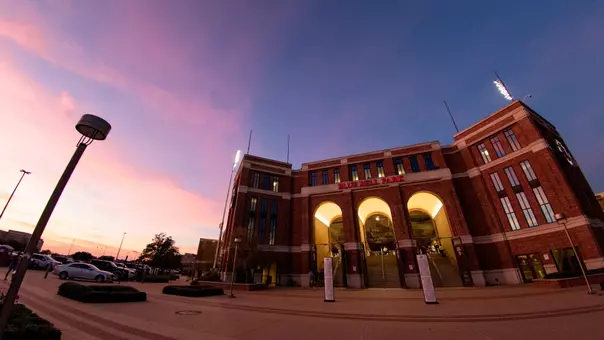
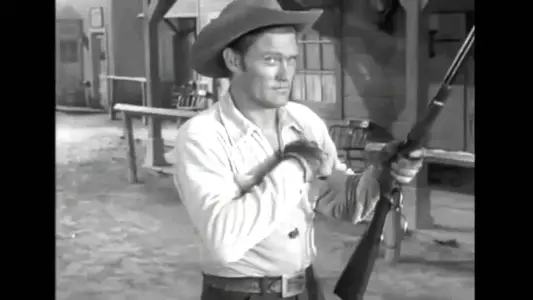
Every strikeout thrown by Texas A&M pitchers on the Olsen Field at Blue Bell Park mound are greeted by the sound of approximately 12 rifle shots (the exact number is debated by 'The Rifleman' fans to this day). Then a strapping man gives his Winchester Model 1892 a twirl, reaches into his chest shirt pocket for a reload cartridge, and then gives the camera a steely glance.
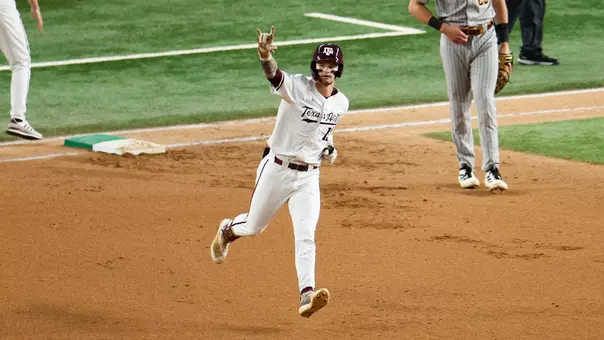
"You hear it," senior pitcher Andrew Vinson said. "It's pretty cool. I've heard it since my freshman year and even when I was being recruited here. It's something that separates A&M from everyone else and it's cool how the crowd gets into it."
On what would be the 95th birthday of actor Chuck Connors (April 20, 1921), we take a look at how 'The Rifleman' became woven into the tapestry of Texas A&M Baseball.
It's a clip that was brought to College Station in the early 1980s by Derrick Grubbs, the former public address announcer at Olsen Field and a 1981 Texas A&M graduate.
"I always liked the show and it was one of my dad's favorites, too," Grubbs said. "I thought it was perfect for baseball."
The iconic clip was nearly relegated to a minor role, but fate stepped in.
"I was originally going to use it when an Aggie catcher threw out a base stealer," Grubbs said. "But when the first game of the season came around, I decided to play it after the first strikeout and it's been played ever since. I think it really worked a lot better after strikeouts than it would have for throwing out runners."
On a good year, the clip will be played well over 400 times. As it evolved, it's been known to have psychological effect.
"I've been on both sides of the mountain," head coach Rob Childress said. "Certainly, the eight years I came here with the University of Nebraska I hated it. I hated everything about it. If it gets going a few times in a row it can become really intimidating. And you knew it wasn't a good thing when you heard it, especially in a clutch situation. The sound could make your heart sink."
No one's heart sank more than Lubbock Christian on April 3, 1993. On that day Jeff Granger set a Southwest Conference single-game strikeout record.
"It played 21 times that day," former Aggie head coach Mark Johnson said. "I never really thought about whether or not it built up any momentum, but I imagine it had to have helped get the crowd into it that evening. That was the biggest part of it early on. I liked to do things very conservative and D.D. (Grubbs) was pretty liberal with what he wanted to do. I didn't want to do anything that would put down the other team. I think it is something good to get the crowd involved."
Now that Coach Childress is on the other side of the mountain, he's developed an appreciation for The Rifleman.
"The last 11 years, it's been a pretty special sound," Childress said. "It's a real special feeling when you hear 'The Rifleman' in a big spot. I would put it at the top of the list as far as things you hear as far as college baseball tradition.
The story of Kevin Joseph (Chuck) Connors is just as intriguing as his presence at Olsen Field.
His frequent appearances on the videoboard at Blue Bell Park aren't Connors' only tie to baseball. The Brooklyn, New York native enjoyed a Major League career. Signed by the hometown Dodgers in 1940, Connors baseball career took detour for World War II.
As his army stint was coming to an end, Connors was able to play basketball for the Rochester Royals of National Basketball League for the 1945-46 season. He helped the squad win the NBL title. The talent accumulated for the squad included future Cleveland Browns Hall of Fame quarterback Otto Graham and longtime New York Knicks head coach Red Holzman. He then became an "Original Celtic," playing for Boston during their first two seasons (1946-47 and 1947-48). He averaged 4.5 points per game and earned the dubious distinction of becoming the first professional player to break a backboard. His shatter job came on a warmup shot on an improperly assembled hoop.
Connors put his basketball career to rest and turned his attention to baseball. He played one game for the Dodgers in 1949. With his path to playing time blocked by perennial All-Star Gil Hodges, Connors spent a majority of the 1949 campaign and all of the 1950 season in the minors with Montreal. He was traded to the Chicago Cubs in 1951, appearing in 66 games with the Major League squad. He logged 16 runs, five doubles, one triple, two home runs and 18 RBI during the '51 campaign.
He is one of just 12 people to play in the NBA and MLB. The 'Doubled Dozen' also include Danny Ainge, Frank Baumholtz, Gene Conley, Dave Debusschere, Dick Groat, Steven Hamilton, Mark Hendrickson, Cotton Nash, Ron Reed, Dick Ricketts and Howie Schultz.
Connors was also drafted by the Chicago Bears, but never played for the squad.
His baseball career transitioned to Hollywood in 1952, when he spent a season in the Pacific Coast League. The following year he ended his baseball career to pursue acting. In addition to 'The Rifleman', his credits include 'Old Yeller' and 'Soylent Green'.
Although they're not known to have ever attended a game, some members of the Connors family are aware of Chuck's presence at Olsen Field.
"When I was with the Astros in 1993, we were playing the Padres in a nationally televised game on ESPN," Grubbs said. "Mark Portugal was pitching for the 'Stros and racking up a lot of K's. I played the Rifleman there, too. The Astrodome switchboard got a call from California from someone named Michael Connors. I called him back the next day and it turns out it was Chuck Connors' son. Chuck had passed away just a few months before (Nov. 19, 1992) I got the call. He said his dad would have been thrilled two know his TV show theme was being played at ball parks and if he had been alive he would have called himself.
"I told him about the tradition starting at Texas A&M with the student section cocking rifles and he thought that was one of the coolest things he'd ever heard."
Grubbs, currently the Associate AD for Game Production and Fan Experience at UT Arlington, has made several stops across the country working professional baseball stints in Wichita, El Paso, New Orleans, Charlotte and Round Rock as week as his two seasons with the Astros. He has played 'The Rifleman' clip at all of the stops.
"I used 'The Rifleman' every place I worked in pro baseball," Grubbs said. "I felt like it let me take a piece of A&M with me everywhere I went. I couldn't very well play the War Hymn in New Orleans or Charlotte, but I could play 'The Rifleman'. Everywhere I went there were former players from other SWC or Big 12 schools who would remember the clip from Texas A&M and tell me how much they liked it."
It also comes up in conversation with Coach Johnson when talking about his time as the A&M skipper.
"It's crazy," Johnson said. "I've had people come up to me and say 'I remember "The Rifleman".' And I'm always surprised that is what they remember. I think it's just something people leave the ballpark with because they 'get it'. The might not understand some of the other things that go on at Olsen Field, but they can see the connection. With 'The Rifleman' they see it.
Nobody likes it more than the current Aggies.
"I'm not one who can really blow it by anyone," Vinson said. "But it's pretty sweet when you get a batter to swing and miss at strike three and hear 'The Rifleman' as you're headed to the dugout."
You can say it makes him feel so good.