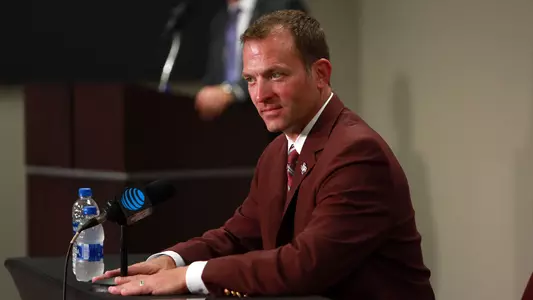
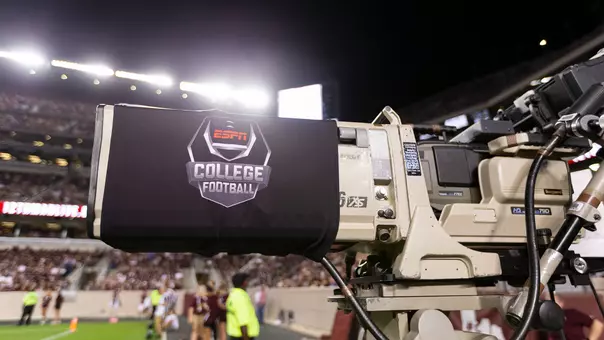
Photo by: JP Beato/Texas A&M Athletics
Ross Bjork Teleconference: April 21
Apr 21, 2020 | General
Quotes from Ross Bjork's April 21, 2020 teleconference are below.
Question: Ross, if you could fill us in with any words of optimism. It seems like we are at least hearing some good news, nationally.
Ross Bjork: I think with each day that goes by we have some certainty. We have some clarity, which gives us optimism that we are reaching, maybe, the peak of all of this, whether it's locally, regionally or as a country. I think with each passing day, when we get more good news and testing becomes more available. With that, we can start to look at what it might look like to operate in terms of how we return to activity, play games and go to school. We are definitely optimistic, for sure. We've been so all along, knowing that we had a lot of time, but that's how we're looking at it at this stage.
Q: How devastating is the oil news?
RB: It's hard to say exactly, because that's an ongoing situation that those folks are dealing with. I don't know how you get the price of a commodity below zero. I don't know enough about the economics of that to fully understand it, but obviously it has an impact. We get it. That's why we've been in constant dialogue with our donors and season ticket holders. We want to be as flexible with them as possible, whatever that impact might be. But that has been devastating news for our economy. And we need to understand that and be ready to react in whatever way that might be.
Q: Major League Baseball has talked about the possible use of Texas as a home base. Have you been in any contact about Bluebell for possibly being used in that situation?
RB: We have not been contacted by Major League Baseball.
Q: Could you tell me who is going to make the final decision on all the NCAA football teams? There are a lot of moving parts, who will finally say the season starts for everyone on September 5th, or whenever it's going to start.
RB: We talked about that a couple weeks ago on this call, about who is the ultimate authority. And I think depending on who you talk to, depending on what region you're in, it may vary. Maybe the county health official may have ultimate authority in your locale. It may be the governor. We obviously know what the White House talked about. The president wants to leave it up to the governors of each state. We see Georgia move forward with some reopening. We see what's happening here locally in our state with a transition to reopen certain things. And we'll have more news on that next week to see what that looks like. It's going to vary. There's not one single source at this point in time that's going to say okay on this date everyone returns, because it is somewhat of a moving target. That is the benefit of where we stand as of April 21st, we still have time. It's way too early to make absolutes on anything at this point in time. We still have time, and I think that's the benefit. But that's a question we talked about at the SEC level, at the university level and at the local level. And right now, there just isn't a single source that can really just say definitively this is how it happens and this is when it happens.
Q: Where are you and your spring coaches with deciding the rosters and what seniors will be coming back looks like? Where are you in that process?
RB: We gave that information to our coaches a few weeks ago, and they want to have those one-on-one conversations. Obviously, they have to do it in a virtual setting. I don't know exactly if all of those have been completed yet, but we did give all of that authority to our coaches to have those conversations. And then as it relates to baseball, baseball is fluid because you've got the roster limitation. It is the only sport that has a roster limitation. You also have the cap on only 27 student-athletes can be on scholarship. There has been a national conversation about maybe expanding what that might look like for one year. We were kind of waiting on some of that information to crystallize. It's still kind of a fluid element for us right now. We do know that we gave that plan to our coaches. They started those conversations, but we don't have that final list quite ready yet.
Q: Ross, to follow up on what you were saying about there being no single entity that's going to make the decision. Are you now seeing where some schools may be able to play this fall and others not? Am I reaching the wrong conclusion?
RB: No, we haven't seen that, yet. Again, I think because of the time frame where we are right now, I think it's too early to make a definitive declaration on that at this point in time. So, we haven't seen that yet. Again, back to what the federal government put out last week about sort of that three-phase plan. I haven't done the analysis to kind of see where every state sits right now. I know Texas, we're in better shape than maybe some other places based on our numbers. So, that's a good trend. We need to keep that going. But we haven't gotten to a point where anybody needs to kind of make that definitive line of, "Okay, this place is ready and this place isn't." I think we're still too early in the process to make that declaration.
Q: There's been a lot of programs that started to make, athletic programs start to make cuts and even some that have cut some programs. Is that even an option you guys are looking at or how close is A&M to making those kind of decisions?
RB: We are fortunate that our budget cycle is a little bit later than some others. Our budget for fiscal year 2020 ends on August 31st. We have a little more time to plan versus most universities. Every university I've ever been at, the fiscal year ends on June 30th. We have a couple more months to really crystallize some of our planning and our operations we have. We have not put that on the table. We don't anticipate putting that on the table. You're going to have a budget, regardless. We talked about this on these calls. We are going to have to tighten our belt. We are going to have less revenue than what we had last year, that's just given the economics of our environment right now. Then you sort of have a mid-tier budget that, maybe, you're not playing games with fans in the stands and that would cause some dramatic cuts and things like that. And then you have the worst case scenario. I mean, really, it's way too early to map out what even that looks like. How do you even operate? I can't fathom how you would even operate under that scenario. We haven't really gone down that far yet, because once again, we have some time. We need more clarity. But we don't anticipate that we'd have to do anything with our sports and how many opportunities that we offer. And we're fortunate from that perspective.
Q: If big league baseball did happen to reach out to you all. Is that something you'd be interested in?
RB: I think so. I think it goes back to what our local health officials say we can do, what kind of mechanics are involved and how that operates. But absolutely. I think if we can get activity and it's safe and we can participate, I think that'd be a great way to kind of get things back, up and running. And so we definitely would participate in that.
Q: You touched on something there. How open are you to a college football season without fans, when you are asked for your input at either the SEC or the NCAA level. And where would that leave college football in general financially?
RB: My priorities at this point in time are the health and safety of our fans, our players, our workers and everybody in our society. And then the second thing would be that we want to play 12 games. We want a full schedule of games, and if that means we need to delay a little bit, then we would. The third thing is we want full stadiums. I think that's the experience that our student-athletes signed up for. That's what the fan expectation is. That's what our communities expect and really rely upon from an economic standpoint. That is how we have to prioritize in terms of how we would look at the college football season. Would we play without fans? Of course, if that's what the players want to do and we could make it safe. We would operate that way, but that's not ideal. I don't think that's what the experience is all about for mainly our players, but also the communities that we live in. That's how we prioritized it. As far as what those numbers are and things like that, it's somewhat early to speculate on the full effect because we don't know. Could you have some people in your stadiums? Is that social distancing? Is it six feet apart, right? I mean, there are so many scenarios out there that people are contemplating that we just haven't done the math on that, because we want more clarity. And we do have some time to figure these things out.
Q: Coaches in other places have been talking about deferring. Have you talked about any deferments or anything like that?
RB: We've looked at lots of different models in terms of some of the cost cutting or revenue and things like that. That would be one of them. But we haven't approached anybody. We haven't looked at that specifically. It would be on the list of things, but I think you don't want to impact your people. I don't really care how much they make. I think it's the first thing you do, you want to protect your people, and that's what we would look to do. It would be on the list, but we haven't approached it. We haven't gone in depth on it. We haven't had that conversation at the university level. I think that's where it has to start at the university level, and it just hasn't come up with that level.
Q: On that coaching salary front, I'm wondering if the season is affected from a revenue perspective moving forward, how do you expect college coaching salaries to be impacted in the future? If you'll have to make significant belt-tightening adjustments moving forward based on the revenue game this season.
RB: I believe it depends on how you operate. If you're not playing a full schedule, then maybe you look at some adjustments. It all depends on how we are formatted, how we operate. Is it a full schedule of games? Is it full stadiums? Those are the things that would be the first sort of determination of how we would look at that. So again, until we know that clarity, we would be way too early to really speculate on that.
Q: If some places, like the Pac-12 area, couldn't completely play. Do you think the college football season could proceed without one of the major conferences participating?
RB: To me, at this point time, with all these different scenarios, you're looking at all of those. What happens if certain regions are ready and others are not? We know the leadership in California has stated about public events, large gatherings. We know what the mayor of Los Angeles has talked about. So, that would impact USC and UCLA. I believe Alabama plays USC to open the season, and if Alabama is ready and USC is not, what happens there? I think all those different scenarios you have to look at as we contemplate this rollout of return to activity. I don't know what that means. There are contracts and there are force majeure language. Those contracts, there are cancellation policies. Is it a forfeiture? We don't know all those things at this point in time, but all of those things are being processed, reviewed and looked at. And that's where you really hope that the conference commissioners really come together at obviously the Power 5 level, but also the FBS level in that there is some uniformity on how we return to activity and how we return to play.
Q: Hey, Ross, how is your interaction with your guys that could get drafted here this next weekend? Are you going to do anything different or special for them with considering the circumstances?
RB: I'd probably give that to Alan, Brad and Mike from a PR standpoint. Obviously, we will be promoting a lot of things, just like we did for the Maroon and White Day on Saturday. There will be a lot of social media activity. We'll be promoting those guys throughout the weekend, starting on Thursday, hopefully. If Justin gets picked in the first round. He is close, I think. We will be doing a lot of hype with a lot of activity, and it is all built on promoting those guys, supporting those guys. I don't know the specific plans yet, but I know we'll do a lot, because that's where we live in. Coach Price took over Twitter with his barbecue challenge on Saturday. We want to try to do as much as we can this weekend.
Q: The President of South Carolina last week came out and said that he hoped he'd be making a decision on all classes by May 15. The school was also saying the drop dead date was June 15 to make a decision on all classes. What are the key deadlines out there when schools make a decision on bringing students back for fall?
RB: Definitely, and luckily we are part of that conversation. Here at Texas A&M University, what does the fall look like? Those conversations are happening right now. I have not been told an exact timeline of when a fall class decision will be made, but I know it is being discussed and there are different models and things like that. I think, really, the key to all of that is what does normalcy look like in higher education? I've heard a lot of talk that there is no way that we can play games. Whether students are back or not back on campus, what does that even mean right now? What does a new normal higher-education experience look like? I think until we know that answer, I think it is way too early to make a proclamation that we can't play sports without students. And so to me, if we make it safe and there is an operational method involved in your university and your university is open, then to me the extra-curricular activities, not just athletics those are things that students want. That's why they came here is for that social aspect, that extra-curricular aspect. I think it's, again, way too early to make any sort of proclamations, but we don't even know what normalcy will look like in the higher ed world. There could be lots of modifications that benefit students, and student-athletes would be a part of that as well.
Q: It's a little unconventional this year, but this is your first time being around with muster. What is your initial reactions on that, and the things that, I guess, that you've seen from it, virtually anyways.
RB: I was scheduled to speak tonight in Williamson County at their muster ceremony, and I just recorded a short little video for them. Just to be able to call the roll this morning, I think I was on right around Lyle Lovett. I guess if I could share some airtime with Lyle Lovett, that's pretty cool, since he's a world-famous singer and an Aggie. The meaning of it and how we honor the past, the history and everybody that came before us, I think is so special here at A&M. To be asked to do it is, is very humbling, and I am appreciative of the opportunity. I think I pronounced everyone's name correctly; they gave me a good guide. It was really a pleasure to honor those folks this morning.
Q: Ross during the summertime you guys, traditionally do the coaches nights around the state and that sort of thing. Texas is looking at reopening, to some extent. Has there been a decision made as to whether you will be doing those or not?
RB: I know we've talked about virtual settings, but I don't think there has been a final decision.
Mike Wright: Now the Association of Former Students is looking at some options for that. Up to and including, maybe, one coaches night overall. But that even has just been in the discussion stage. Our program is looking at a number of options, I think that's all up for discussion. Chuck, I know that Dallas runs one of the best of those coaches nights, but right now, all of them are on hold.
RB: My guess is, Chuck, we'll do something in a virtual setting at this point in time. That would be my guess. That has been the neat thing about this. We have had several sessions with Coach Fisher with donors and supporters. I mean he's got time; we've all got time. We have all enjoyed doing these types of things, so I'm sure we'll do something in the virtual setting.
Q: How different is the virtual thing with donors, than it is from the standard in-person, shaking hands, talking over drinks or whatever you guys do when you meet?
RB: At this point, you can't really play golf over zoom, right? Not that we play a lot of golf, but what has been cool about it is, they love the interaction. They just love some sort of face time interaction and some dialogue. I think from that standpoint it has been really neat to see how fired up people are about taking your call, taking a meeting or things like that. It's different, obviously, you're not sitting there having lunch or doing those things in a social setting. But at least you are able to make contact through all this technology, and they've appreciated it. That has been neat to see.
Q: When you consider future plans from a big picture perspective, how do smaller issues that are not really small, like contracts, bye weeks and payouts, factor into those discussions as we all try to model stuff out?
RB: Again, when you're analyzing, if you are moving things around and if there's an adjustment to the schedule, you have to start with the contractual relationship. What does it say, who wrote the content, did we write the contract or did the contract come from the other party. You look at all those things, but I think right now with the prioritization of what we deal with on a daily basis, you've got to be laser focused. With some of the smaller things, you can say we are not going to look at that right now, we are going to set that aside. We have to worry about the return to activity, playing the seasons and things like that. That's how we have kind of looked at some of those contractual things right now. If it's a game then we have to look at it in depth. Other things we will set it aside and deal with it later.
Q: Ross, last couple weeks you did not have any personal contact with your staff?
RB: I have not had any face-to-face contact. I was up in my office the other day, and I saw a few staff members from a distance. But what was really neat, last week we hosted an all-department staff meeting on Zoom. And we had a tremendous guest speaker, Dr. Rick Rigsby. He gave us a great talk on motivation, hope, clarity and really just being a leader. I was able to kind of scroll through the screen and see a bunch of folks on the meeting. And then we did a head coach's call two weeks ago, I guess. I speak to Jimbo, maybe every other day or so. I spoke to Buzz Friday and Saturday. There is constant dialogue out there, we are trying to stay in touch and interact with folks the best we can. But seeing people in person, we've limited that based on trying to be safe.
Q: Ross, have you learned to keep an eye on oil prices, first of all? Also, would you mind addressing the idea, the notion of what I think is a myth that A&M's athletic budget is dependent entirely on oil prices?
RB: Well, I made sure I had the Commodity app on my phone, I think, the day that I started, on July 8th. You've got to pay attention to that living here in Texas. We probably have to do a really in-depth survey to figure out exactly what the totals are of our donor base, season ticket holder base and what industry that they are in. We have a lot of smart people and obviously, if you're in the oil business or not, you've gone through a wave of ups and downs, but especially in the oil business. I think these folks know how to weather storms. This is obviously a little bit different one. We hope it's not long term, but I think these folks are smart. I think they diversify themselves so they come out of it. They get better. They sharpen their pencil. So, it's hard to say exactly how much we're dependent on it. I'd really have to do an in-depth study on that, but we know it'll have an impact. We know that people, their livelihood is depending, no matter what channel you're positioned, in the oil supply chain. You are going to be impacted. How do we deal with them? That's the key. How do we deal with them? How do we have that compassion, that interaction, the flexibility? That's what we will adapt to as much as anything, is working with them the best that we can.
Q: I was just curious from your standpoint as an AD, do you have any personal stories on Justin [Madubuike]? I'm just curious if you had any personal recollections or encounters with him and what struck you about him as a person?
RB: I could tell right away Justin had a different motor when I started watching practice last fall. And then we all know my previous institution was Ole Miss. I went down to the field, at the end of the third quarter of that game back in October and that game was pretty important. We needed to win that game. And some of the players were kind of teasing me on the trip like, "Hey we're going back to your old place" or "who are you going to cheer for?" I'm like, "Guys, come on. I'm wearing Maroon." I remember the second half of that game Justin seemed to kind of turn it up a notch, he was at a different level. Especially in the second half of that game, and obviously we had to make some big stops on defense because it was a close game. And I just remember in the locker room just thanking him, "Hey man, thank you. Thanks for getting this one." He said, "I know this was important to you Mr. Ross." He is a great young man. He always had a smile on his face, very intense and a great player. Sealing that Ole Miss win on defense, that was important.
Q: If and when they come out with a vaccine for the coronavirus, or COVID-19, would you be on board with it being added to Texas University's vaccine list, like they do polio, measles and all those others?
RB: If that is what the university has as a priority, then absolutely we would be all over that, help promote it and just participate in whatever platform. I know there are a lot of people here at A&M and the research area. We have pandemic experts here on campus and it is pretty fascinating to see the leadership that is taking place, across our entire system, but especially here in College Station. Absolutely, we'd be fired up to participate in whatever that would look like.
Q: If I could go back to this idea of who makes decisions for sports. There are a lot of different moving parts with TV partners, athletics directors, coaches and administrators. Has anything that's happened, and I realize this is unprecedented, but has anything that has happened made you rethink the structure in terms of decision making for the sport?
RB: Nothing at this point in time. I think that's where we are fortunate to have Commissioner Sankey as our leader. I think we have a great group of presidents within the SEC right now that have national perspectives or serve on national committees. I think we are fortunate, but no, nothing has caused governance issues or anything like that at this stage. I think there is going to be a debrief and an aftermath analysis for everything that has taken place. Depending on what happens, there is going to be some uniform coordination and those types of things. Right now there hasn't been a moment where we had to take a step back and really analyze the structure at this point. Everybody is just trying to get through this. We are trying to find the end game, and the ending point. Nothing is causing that, at least from my perspective.
Q: I know last time we talked you mentioned that you guys would formulate a plan on how to release the new football uniforms. Have you guys taken everything from how some of the NFL teams have done it, as far as the marketing aspect of unveiling a new set of threads?
RB: That hasn't hit my desk yet, but our creative team is talking weekly, our external team is talking weekly about what that plan looks like. I think it was the Patriots or the Chargers who revealed their uniform yesterday. We will look at how to be creative. Obviously, it will be a virtual setting, but I know our folks are working on that.
Question: Ross, if you could fill us in with any words of optimism. It seems like we are at least hearing some good news, nationally.
Ross Bjork: I think with each day that goes by we have some certainty. We have some clarity, which gives us optimism that we are reaching, maybe, the peak of all of this, whether it's locally, regionally or as a country. I think with each passing day, when we get more good news and testing becomes more available. With that, we can start to look at what it might look like to operate in terms of how we return to activity, play games and go to school. We are definitely optimistic, for sure. We've been so all along, knowing that we had a lot of time, but that's how we're looking at it at this stage.
Q: How devastating is the oil news?
RB: It's hard to say exactly, because that's an ongoing situation that those folks are dealing with. I don't know how you get the price of a commodity below zero. I don't know enough about the economics of that to fully understand it, but obviously it has an impact. We get it. That's why we've been in constant dialogue with our donors and season ticket holders. We want to be as flexible with them as possible, whatever that impact might be. But that has been devastating news for our economy. And we need to understand that and be ready to react in whatever way that might be.
Q: Major League Baseball has talked about the possible use of Texas as a home base. Have you been in any contact about Bluebell for possibly being used in that situation?
RB: We have not been contacted by Major League Baseball.
Q: Could you tell me who is going to make the final decision on all the NCAA football teams? There are a lot of moving parts, who will finally say the season starts for everyone on September 5th, or whenever it's going to start.
RB: We talked about that a couple weeks ago on this call, about who is the ultimate authority. And I think depending on who you talk to, depending on what region you're in, it may vary. Maybe the county health official may have ultimate authority in your locale. It may be the governor. We obviously know what the White House talked about. The president wants to leave it up to the governors of each state. We see Georgia move forward with some reopening. We see what's happening here locally in our state with a transition to reopen certain things. And we'll have more news on that next week to see what that looks like. It's going to vary. There's not one single source at this point in time that's going to say okay on this date everyone returns, because it is somewhat of a moving target. That is the benefit of where we stand as of April 21st, we still have time. It's way too early to make absolutes on anything at this point in time. We still have time, and I think that's the benefit. But that's a question we talked about at the SEC level, at the university level and at the local level. And right now, there just isn't a single source that can really just say definitively this is how it happens and this is when it happens.
Q: Where are you and your spring coaches with deciding the rosters and what seniors will be coming back looks like? Where are you in that process?
RB: We gave that information to our coaches a few weeks ago, and they want to have those one-on-one conversations. Obviously, they have to do it in a virtual setting. I don't know exactly if all of those have been completed yet, but we did give all of that authority to our coaches to have those conversations. And then as it relates to baseball, baseball is fluid because you've got the roster limitation. It is the only sport that has a roster limitation. You also have the cap on only 27 student-athletes can be on scholarship. There has been a national conversation about maybe expanding what that might look like for one year. We were kind of waiting on some of that information to crystallize. It's still kind of a fluid element for us right now. We do know that we gave that plan to our coaches. They started those conversations, but we don't have that final list quite ready yet.
Q: Ross, to follow up on what you were saying about there being no single entity that's going to make the decision. Are you now seeing where some schools may be able to play this fall and others not? Am I reaching the wrong conclusion?
RB: No, we haven't seen that, yet. Again, I think because of the time frame where we are right now, I think it's too early to make a definitive declaration on that at this point in time. So, we haven't seen that yet. Again, back to what the federal government put out last week about sort of that three-phase plan. I haven't done the analysis to kind of see where every state sits right now. I know Texas, we're in better shape than maybe some other places based on our numbers. So, that's a good trend. We need to keep that going. But we haven't gotten to a point where anybody needs to kind of make that definitive line of, "Okay, this place is ready and this place isn't." I think we're still too early in the process to make that declaration.
Q: There's been a lot of programs that started to make, athletic programs start to make cuts and even some that have cut some programs. Is that even an option you guys are looking at or how close is A&M to making those kind of decisions?
RB: We are fortunate that our budget cycle is a little bit later than some others. Our budget for fiscal year 2020 ends on August 31st. We have a little more time to plan versus most universities. Every university I've ever been at, the fiscal year ends on June 30th. We have a couple more months to really crystallize some of our planning and our operations we have. We have not put that on the table. We don't anticipate putting that on the table. You're going to have a budget, regardless. We talked about this on these calls. We are going to have to tighten our belt. We are going to have less revenue than what we had last year, that's just given the economics of our environment right now. Then you sort of have a mid-tier budget that, maybe, you're not playing games with fans in the stands and that would cause some dramatic cuts and things like that. And then you have the worst case scenario. I mean, really, it's way too early to map out what even that looks like. How do you even operate? I can't fathom how you would even operate under that scenario. We haven't really gone down that far yet, because once again, we have some time. We need more clarity. But we don't anticipate that we'd have to do anything with our sports and how many opportunities that we offer. And we're fortunate from that perspective.
Q: If big league baseball did happen to reach out to you all. Is that something you'd be interested in?
RB: I think so. I think it goes back to what our local health officials say we can do, what kind of mechanics are involved and how that operates. But absolutely. I think if we can get activity and it's safe and we can participate, I think that'd be a great way to kind of get things back, up and running. And so we definitely would participate in that.
Q: You touched on something there. How open are you to a college football season without fans, when you are asked for your input at either the SEC or the NCAA level. And where would that leave college football in general financially?
RB: My priorities at this point in time are the health and safety of our fans, our players, our workers and everybody in our society. And then the second thing would be that we want to play 12 games. We want a full schedule of games, and if that means we need to delay a little bit, then we would. The third thing is we want full stadiums. I think that's the experience that our student-athletes signed up for. That's what the fan expectation is. That's what our communities expect and really rely upon from an economic standpoint. That is how we have to prioritize in terms of how we would look at the college football season. Would we play without fans? Of course, if that's what the players want to do and we could make it safe. We would operate that way, but that's not ideal. I don't think that's what the experience is all about for mainly our players, but also the communities that we live in. That's how we prioritized it. As far as what those numbers are and things like that, it's somewhat early to speculate on the full effect because we don't know. Could you have some people in your stadiums? Is that social distancing? Is it six feet apart, right? I mean, there are so many scenarios out there that people are contemplating that we just haven't done the math on that, because we want more clarity. And we do have some time to figure these things out.
Q: Coaches in other places have been talking about deferring. Have you talked about any deferments or anything like that?
RB: We've looked at lots of different models in terms of some of the cost cutting or revenue and things like that. That would be one of them. But we haven't approached anybody. We haven't looked at that specifically. It would be on the list of things, but I think you don't want to impact your people. I don't really care how much they make. I think it's the first thing you do, you want to protect your people, and that's what we would look to do. It would be on the list, but we haven't approached it. We haven't gone in depth on it. We haven't had that conversation at the university level. I think that's where it has to start at the university level, and it just hasn't come up with that level.
Q: On that coaching salary front, I'm wondering if the season is affected from a revenue perspective moving forward, how do you expect college coaching salaries to be impacted in the future? If you'll have to make significant belt-tightening adjustments moving forward based on the revenue game this season.
RB: I believe it depends on how you operate. If you're not playing a full schedule, then maybe you look at some adjustments. It all depends on how we are formatted, how we operate. Is it a full schedule of games? Is it full stadiums? Those are the things that would be the first sort of determination of how we would look at that. So again, until we know that clarity, we would be way too early to really speculate on that.
Q: If some places, like the Pac-12 area, couldn't completely play. Do you think the college football season could proceed without one of the major conferences participating?
RB: To me, at this point time, with all these different scenarios, you're looking at all of those. What happens if certain regions are ready and others are not? We know the leadership in California has stated about public events, large gatherings. We know what the mayor of Los Angeles has talked about. So, that would impact USC and UCLA. I believe Alabama plays USC to open the season, and if Alabama is ready and USC is not, what happens there? I think all those different scenarios you have to look at as we contemplate this rollout of return to activity. I don't know what that means. There are contracts and there are force majeure language. Those contracts, there are cancellation policies. Is it a forfeiture? We don't know all those things at this point in time, but all of those things are being processed, reviewed and looked at. And that's where you really hope that the conference commissioners really come together at obviously the Power 5 level, but also the FBS level in that there is some uniformity on how we return to activity and how we return to play.
Q: Hey, Ross, how is your interaction with your guys that could get drafted here this next weekend? Are you going to do anything different or special for them with considering the circumstances?
RB: I'd probably give that to Alan, Brad and Mike from a PR standpoint. Obviously, we will be promoting a lot of things, just like we did for the Maroon and White Day on Saturday. There will be a lot of social media activity. We'll be promoting those guys throughout the weekend, starting on Thursday, hopefully. If Justin gets picked in the first round. He is close, I think. We will be doing a lot of hype with a lot of activity, and it is all built on promoting those guys, supporting those guys. I don't know the specific plans yet, but I know we'll do a lot, because that's where we live in. Coach Price took over Twitter with his barbecue challenge on Saturday. We want to try to do as much as we can this weekend.
Q: The President of South Carolina last week came out and said that he hoped he'd be making a decision on all classes by May 15. The school was also saying the drop dead date was June 15 to make a decision on all classes. What are the key deadlines out there when schools make a decision on bringing students back for fall?
RB: Definitely, and luckily we are part of that conversation. Here at Texas A&M University, what does the fall look like? Those conversations are happening right now. I have not been told an exact timeline of when a fall class decision will be made, but I know it is being discussed and there are different models and things like that. I think, really, the key to all of that is what does normalcy look like in higher education? I've heard a lot of talk that there is no way that we can play games. Whether students are back or not back on campus, what does that even mean right now? What does a new normal higher-education experience look like? I think until we know that answer, I think it is way too early to make a proclamation that we can't play sports without students. And so to me, if we make it safe and there is an operational method involved in your university and your university is open, then to me the extra-curricular activities, not just athletics those are things that students want. That's why they came here is for that social aspect, that extra-curricular aspect. I think it's, again, way too early to make any sort of proclamations, but we don't even know what normalcy will look like in the higher ed world. There could be lots of modifications that benefit students, and student-athletes would be a part of that as well.
Q: It's a little unconventional this year, but this is your first time being around with muster. What is your initial reactions on that, and the things that, I guess, that you've seen from it, virtually anyways.
RB: I was scheduled to speak tonight in Williamson County at their muster ceremony, and I just recorded a short little video for them. Just to be able to call the roll this morning, I think I was on right around Lyle Lovett. I guess if I could share some airtime with Lyle Lovett, that's pretty cool, since he's a world-famous singer and an Aggie. The meaning of it and how we honor the past, the history and everybody that came before us, I think is so special here at A&M. To be asked to do it is, is very humbling, and I am appreciative of the opportunity. I think I pronounced everyone's name correctly; they gave me a good guide. It was really a pleasure to honor those folks this morning.
Q: Ross during the summertime you guys, traditionally do the coaches nights around the state and that sort of thing. Texas is looking at reopening, to some extent. Has there been a decision made as to whether you will be doing those or not?
RB: I know we've talked about virtual settings, but I don't think there has been a final decision.
Mike Wright: Now the Association of Former Students is looking at some options for that. Up to and including, maybe, one coaches night overall. But that even has just been in the discussion stage. Our program is looking at a number of options, I think that's all up for discussion. Chuck, I know that Dallas runs one of the best of those coaches nights, but right now, all of them are on hold.
RB: My guess is, Chuck, we'll do something in a virtual setting at this point in time. That would be my guess. That has been the neat thing about this. We have had several sessions with Coach Fisher with donors and supporters. I mean he's got time; we've all got time. We have all enjoyed doing these types of things, so I'm sure we'll do something in the virtual setting.
Q: How different is the virtual thing with donors, than it is from the standard in-person, shaking hands, talking over drinks or whatever you guys do when you meet?
RB: At this point, you can't really play golf over zoom, right? Not that we play a lot of golf, but what has been cool about it is, they love the interaction. They just love some sort of face time interaction and some dialogue. I think from that standpoint it has been really neat to see how fired up people are about taking your call, taking a meeting or things like that. It's different, obviously, you're not sitting there having lunch or doing those things in a social setting. But at least you are able to make contact through all this technology, and they've appreciated it. That has been neat to see.
Q: When you consider future plans from a big picture perspective, how do smaller issues that are not really small, like contracts, bye weeks and payouts, factor into those discussions as we all try to model stuff out?
RB: Again, when you're analyzing, if you are moving things around and if there's an adjustment to the schedule, you have to start with the contractual relationship. What does it say, who wrote the content, did we write the contract or did the contract come from the other party. You look at all those things, but I think right now with the prioritization of what we deal with on a daily basis, you've got to be laser focused. With some of the smaller things, you can say we are not going to look at that right now, we are going to set that aside. We have to worry about the return to activity, playing the seasons and things like that. That's how we have kind of looked at some of those contractual things right now. If it's a game then we have to look at it in depth. Other things we will set it aside and deal with it later.
Q: Ross, last couple weeks you did not have any personal contact with your staff?
RB: I have not had any face-to-face contact. I was up in my office the other day, and I saw a few staff members from a distance. But what was really neat, last week we hosted an all-department staff meeting on Zoom. And we had a tremendous guest speaker, Dr. Rick Rigsby. He gave us a great talk on motivation, hope, clarity and really just being a leader. I was able to kind of scroll through the screen and see a bunch of folks on the meeting. And then we did a head coach's call two weeks ago, I guess. I speak to Jimbo, maybe every other day or so. I spoke to Buzz Friday and Saturday. There is constant dialogue out there, we are trying to stay in touch and interact with folks the best we can. But seeing people in person, we've limited that based on trying to be safe.
Q: Ross, have you learned to keep an eye on oil prices, first of all? Also, would you mind addressing the idea, the notion of what I think is a myth that A&M's athletic budget is dependent entirely on oil prices?
RB: Well, I made sure I had the Commodity app on my phone, I think, the day that I started, on July 8th. You've got to pay attention to that living here in Texas. We probably have to do a really in-depth survey to figure out exactly what the totals are of our donor base, season ticket holder base and what industry that they are in. We have a lot of smart people and obviously, if you're in the oil business or not, you've gone through a wave of ups and downs, but especially in the oil business. I think these folks know how to weather storms. This is obviously a little bit different one. We hope it's not long term, but I think these folks are smart. I think they diversify themselves so they come out of it. They get better. They sharpen their pencil. So, it's hard to say exactly how much we're dependent on it. I'd really have to do an in-depth study on that, but we know it'll have an impact. We know that people, their livelihood is depending, no matter what channel you're positioned, in the oil supply chain. You are going to be impacted. How do we deal with them? That's the key. How do we deal with them? How do we have that compassion, that interaction, the flexibility? That's what we will adapt to as much as anything, is working with them the best that we can.
Q: I was just curious from your standpoint as an AD, do you have any personal stories on Justin [Madubuike]? I'm just curious if you had any personal recollections or encounters with him and what struck you about him as a person?
RB: I could tell right away Justin had a different motor when I started watching practice last fall. And then we all know my previous institution was Ole Miss. I went down to the field, at the end of the third quarter of that game back in October and that game was pretty important. We needed to win that game. And some of the players were kind of teasing me on the trip like, "Hey we're going back to your old place" or "who are you going to cheer for?" I'm like, "Guys, come on. I'm wearing Maroon." I remember the second half of that game Justin seemed to kind of turn it up a notch, he was at a different level. Especially in the second half of that game, and obviously we had to make some big stops on defense because it was a close game. And I just remember in the locker room just thanking him, "Hey man, thank you. Thanks for getting this one." He said, "I know this was important to you Mr. Ross." He is a great young man. He always had a smile on his face, very intense and a great player. Sealing that Ole Miss win on defense, that was important.
Q: If and when they come out with a vaccine for the coronavirus, or COVID-19, would you be on board with it being added to Texas University's vaccine list, like they do polio, measles and all those others?
RB: If that is what the university has as a priority, then absolutely we would be all over that, help promote it and just participate in whatever platform. I know there are a lot of people here at A&M and the research area. We have pandemic experts here on campus and it is pretty fascinating to see the leadership that is taking place, across our entire system, but especially here in College Station. Absolutely, we'd be fired up to participate in whatever that would look like.
Q: If I could go back to this idea of who makes decisions for sports. There are a lot of different moving parts with TV partners, athletics directors, coaches and administrators. Has anything that's happened, and I realize this is unprecedented, but has anything that has happened made you rethink the structure in terms of decision making for the sport?
RB: Nothing at this point in time. I think that's where we are fortunate to have Commissioner Sankey as our leader. I think we have a great group of presidents within the SEC right now that have national perspectives or serve on national committees. I think we are fortunate, but no, nothing has caused governance issues or anything like that at this stage. I think there is going to be a debrief and an aftermath analysis for everything that has taken place. Depending on what happens, there is going to be some uniform coordination and those types of things. Right now there hasn't been a moment where we had to take a step back and really analyze the structure at this point. Everybody is just trying to get through this. We are trying to find the end game, and the ending point. Nothing is causing that, at least from my perspective.
Q: I know last time we talked you mentioned that you guys would formulate a plan on how to release the new football uniforms. Have you guys taken everything from how some of the NFL teams have done it, as far as the marketing aspect of unveiling a new set of threads?
RB: That hasn't hit my desk yet, but our creative team is talking weekly, our external team is talking weekly about what that plan looks like. I think it was the Patriots or the Chargers who revealed their uniform yesterday. We will look at how to be creative. Obviously, it will be a virtual setting, but I know our folks are working on that.
Fightin' Texas Aggie Band Halftime: Florida
Saturday, October 11
Fightin' Texas Aggie Band Halftime: Mississippi State
Saturday, October 04
Fightin' Texas Aggie Band Halftime: Auburn
Saturday, September 27
Fightin' Texas Aggie Band Halftime: Utah State
Saturday, September 06