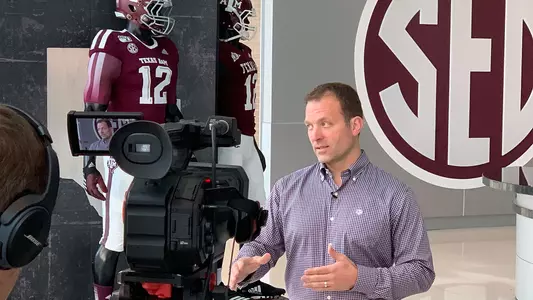
Ross Bjork Teleconference: April 7
Apr 07, 2020 | General
Quotes from Ross Bjork's April 7, 2020 teleconference are below.
Question: There was an A&M decision that you guys wouldn't have or wouldn't be able to host your June athletic camps. What does that mean to you guys as an athletics department? I heard from some coaches about what it means to them in terms of their programming, but is that any money that comes into the athletics department?
Ross Bjork: Obviously we had shut our campus down to pretty much all visitors until May 31st, so this is another progressive step in that. We have all these camps, including academic camps and other similar camps, on campus that are all shut down through the end of June. There is no direct financial impact to the athletics department. All of that revenue goes to our coaching staffs and those respective sports. They have expenses, they have camp workers, so there's obviously staff within that sport who received a financial benefit from those camps. That's what, I think, our coaches were talking about last week. For themselves, it's a major impact and the people that are impacted most in this are the volunteer coaches. The NCAA allows you to have volunteer coaches and their income, their livelihood, is 100-percent generated through those camps. So, that's something that we're trying to provide, some resources to at least point them in the right direction. They're not our employees, but we're trying to point them in the right direction. That's a fallout of this, and we're trying to just give them as many resources as we can. We're still kind of developing some of those plans.
Q: I know it has been a couple of days since the NCAA made the ruling, but is there any timetable? Have you made any framework for the spring coaches to try and have conversations with some of those seniors and what does that kind of look like so far?
RB: We went through a lot of that analysis on Friday and Monday. We're in the process of communicating with each [head] coach of our spring sports to let them know to move forward with your plan or modify this, so some of those conversations may be happening in real time as we're even on this call. They have their plan, the coaches will start to implement that plan, have conversations. Most of the coaches had a pretty good feel and sense of what their seniors were going to do or wanted to do, so we had a pretty good idea, going into Friday and Monday. Now the coaches will go out, start having those conversations and finalize everything.
Q: Ross, what is your feeling on the, I guess idea that if the football season is delayed and playing it in the spring?
RB: To me the first question you have to ask is, what happens to the 2021 season? What is that timing look like? Because you really need four months to play a college football season from the first game. And really it is four-plus months when you include, now, the CFP championship happening sometimes in mid-January. To me that's the first question you have to ask. Okay yeah sure, we can't play in the fall. Let's play in the early 2021, but you have to look at the backside of that from a recovery, health and safety standpoint. Also, it's way too early to even look at models and even be able to comprehend how that would work from a four-month standpoint. That's the first analysis you would have to do is, what happens to the `21 season.
Q: As a former college football player yourself, if you could remember, do you think you could play the season in the spring and again in the fall?
RB: You think you can do anything when you're 21, 22 years old. So, of course. And look at our young men and women, in all of our sports, they compete year round and they train year round. I think young people want to compete. What I'm hearing from our young people is they just want to play now that they've had this detachment. They just want to play. They want us to tell them when they can play, but we don't have that answer, yet. The health and safety has to come first and foremost, so that's what we're focused on right now.
Q: I've talked to a bunch of coaches who have either experienced this kind of offseason, or know about it. There was a day when players were just sent home with a set of instructions and showed up in August. I know you weren't, but Matt Campbell and I were at Iowa State Division III, and that's the way they operated. Could this be a reexamination of if we need this to be an 11- or 12-month sport?
RB: Perhaps, and then you layer in the academic piece. They're here the whole month of June, the whole month of July. Then they are in classes and there are a lot of orientation sessions that take place, a lot of bridge programs to prepare them for the fall in their academic career. It's a year-round aspect. In some ways, I remember when I played my last college season was 1994. You ran a little bit in June, and then right after July 4 it was like, 'okay, now you have to get serious.' I mean that's kind of how we did it, because you want to be prepared. That first day when you have to run those six gassers, or whatever your fitness test was, you wanted to be ready for that. But then you really use two-a-days to really get in game shape. That was the model back then. Obviously times have changed, but perhaps that's how we look at it. Is there an adaptation in which the physical toll needs to be re-examined?
Q: What kind of feedback are you getting from your coaches on the fact that the one-time transfer rule may come about?
RB: Most of our coaches, I think they just want clarity. We know that the waiver process in the past couple years really has not worked. There's not a lot of transparency on why certain waivers get approved and why certain ones don't. I think, as an industry, we just want clarity. Talking to our coaches here at Texas A&M for the five sports that don't have immediate eligibility, they just want to know what the rules are. Tell us what we need to do to adapt. If the waiver process is a little more lenient on the first time, then we'll have to deal with that and manage accordingly. I look at transfers like, if you have a sound program, you're going to have some kids that leave. We know that. If those young men and women don't want to be here we want to put them in the best position to move on. But if you have problems in your program then you're going to have a lot of transfers, and that's a bigger issue that universities have to deal with. We're hoping for some clarity. Again, given all these virus issues that we are in right now, I'm not sure when we'll get the clarity, but conversations are still happening about the transfer world.
Q: Will this make coaches, maybe, develop a different relationship with players? One Big 10 AD said just recruit better players, not talent wise, but just culture wise.
RB: It just comes down to chemistry, relationships and the kind of culture that's in your program. Obviously, recruiting and roster management are a big deal. You want competition, but if you have a lot of players leaving, did you recruit the right way? Are there too many people without one position? My son, Payton, is 13 and he follows recruiting. We were looking back at some of the last couple elite 11 quarterback classes. I think in the last two or three classes, only three or four of the quarterbacks in each class are still at their original school. They have all transferred, so why is that? It definitely causes you to examine how you write your programs.
Q: Have you had conversations with Jimbo [Fisher] discussing a drop-dead date for the guys reporting, how long would it take to get a team prepared?
RB: Just in a general sense we kind of use 45 to 60 days. Some of that will be dependent on each individual person, right. Some guys may take longer than 60 days, some guys may take 50 days. But we really just kind of talked in a general sense. I think until we see where we are on May 1st, it's kind of too early to predict when we would start or how we would start. I mean it seems like there has been some good news in the last couple days, relative to the curve and some of the modeling that was out there a few weeks ago. But we know one thing about models, they are not accurate. You need real data, and I think we will have some real data here around May 1st. We actually spoke yesterday about some general ideas as things are kind of being kicked around nationally. Then it also depends on what happens in those 60 days. Are you able to talk more football, are you able to have walk-thrus? Obviously you've got to have the physical part, but is there more of the coaching in the mental part, the playbook planning and things like that you can do in that timeframe? I think that is just as important as the physical piece if you're really prepping perhaps on a shorter window. So, a lot of it depends on what we're able to do whenever we get back to that togetherness.
Q: Who will ultimately make that decision?
RB: That's a great question. The scenarios that I have thrown out are we play Colorado in week three. Let's say we are farther ahead based on our health experts and we are able to get back to normalcy sooner than the State of Colorado. We play them in week three. What happens then? I think it's going to be layered. I think you have to go based on your health experts. Obviously, we are going to follow our conference leaders, our university leaders. How is your university operational? What is your state government saying about your health environment? It's not just one body, one person, one league. This is a multifaceted decision. I know the Power Five autonomy, five conferences are speaking at the commissioner level on a regular basis. There is dialogue happening about some uniformity, but there is not really one trigger point that says everybody is back on this date in this environment. And that is going to be the challenging part once we do get back up and running.
Q: There was an ESPN article about Alabama using tech to keep track of their players' health. I just wanted to get your reaction to that and are you guys implementing anything like that, like Apple Watches.
RB: We all have technology that we use on our campuses. We have a system here that tracks information and Jimbo refers to it a lot in terms of the load and things like that. We all have that technology, so when they leave campus I think that was a little bit of a new wrinkle for all of us. Our understanding is that it's health and safety, which is all permissible. We can't track workouts. We can't film anything right now. We can't watch any drills that the athletes are doing on their own or lifting. We can't do any of that stuff, so you can't use it to monitor that aspect of it. We don't have any plans right now to send anything off or anything like that. We are just making sure that our guys are staying safe, giving them the voluntary workouts, making sure that they are following all the safety precautions, staying healthy and just kind of monitoring that way. But we don't have any plans right now to send any sort of technology out at this point.
Q: With all the contingencies being talked about out there, stuff that you hear internally or talking to your peers, is there anything that you heard that makes you kind of wince a little bit? Whether it's football without fans or conference only or, as we talked about, spring football. Or are you kind of open-minded at this point to what needs to be done to have some kind of football season?
RB: I think in a lot of cases we are all just guessing, really. I mean, we don't know exactly what the data will tell us or what our health experts will tell us. We can look at what happens May 1st and June 1st. We need 60 days. I mean we can make a model, but until you know when you're starting, when you can have some togetherness, until then it's really hard to predict opening weekends. Is there a delay, is there shortened seasons, is it moved to 2021? To me, if there has to be a progressive sort of opening season, saying we have to start here and then we work our way up to full stadiums, I think all of us would be on board with playing the season in the best environment possible to make sure that we give these kids a great experience with stadiums that have season ticket holders in them. We know the revenue piece is highly important to how we run our programs, but there is nothing that I've heard that makes me wince or anything. I think it's the unknown that we all keep kind of running through our heads, going 'okay what if this happens, what if that happens.' And to me, it's just way too early at this stage.
Q: What is the next step, progressive step, that you would like to see on May 1st to give you these hopes that there could be football on schedule? And the second thing, if that football season does continue in the fall are you already starting to game-plan with hand sanitizer stations, social distancing and all that stuff that people were going to try to do in March, but then had to cancel?
RB: The biggest sign of data that we'll look for is have the health experts told us that we've reached the peak, that we are on the downhill side of the curve. Do we have that window out there so that we know that we have this virus in the best containable position possible and that it is coming down, and that all this social distancing has worked? That's the biggest piece of data that we need. When that's out there, then we can start to model out return to activity, what the summers look like, things like that. Here at Texas A&M, we have unbelievable experts tracking this, we have a Health Sciences Center and we have a school of public health. We are getting great guidance from them, as well, in terms of those models and what position that will be. I want the medical expert data. And then when we've talked in a general sense about stadium preparations and sanitizing, let's just say that we have some limited return to activity. What do we do with our athletes? Do we test all of our athletes? We don't know that answer, yet. Do we test all of our coaching staff? Do they have their own little community for a while? Are they in the same complex? Those are some of the things that we're talking about, but it is hard to operationalize some of those components.
Q: What do you think the next step for the NCAA will be, or the SEC will be, for you all? Is it more access to the players in May? What do you think they are going to let you do?
RB: Good question. We are having daily calls. Again, sort of the Apple Watch thing maybe spurred some ideas. I would like to be able to monitor our student-athletes a little more closely. Not for the competitive piece, but for the health and safety piece. I think, if this thing does go longer into the summer, we are going to have to introduce some elements. I don't know what those are right now. I don't know if that is everybody on a Zoom call, and we can watch them work out that way. I don't know what those concepts are yet, but I think the longer this goes on, you do have some return to activity that you need them in the best possible physical condition so that they don't get hurt when they when they do come back. I think the longer this goes, I think we will talk about more ideas and what those are. No one has come up with them yet, but I think you are onto something. If we are in this position a little bit longer, I think you'll need some more monitoring, if you will, on the physical side.
Q: Have you had any players or coaches test positive?
RB: We have not. We had a few student-athletes who had some family members, but they got themselves in the best position possible. We have not had any staff members, student-athletes, or family members of staff members to our knowledge test positive.
Q: I saw that you put on Twitter this weekend the possibility of going back to retro uniforms, is that something you would want to elaborate on?
RB: I'm going to follow the lead of Kellen Mond. 'Oh you haven't heard yet.' No, we had a little fun with that on Twitter over the weekend. Kellen is a great young man, and obviously we were both bored so we had to talk about uniforms. But we had a plan with the spring game that would have been a week from this coming Saturday, April 18th. We had a plan to start unveiling what the new uniforms would look like for the 2020 season, but I can't really just do that over this call. You'll have to wait, but we'll have a plan to launch everything and showcase what the new uniforms will look like.
Q: The doomsday scenario that we don't have college football in 2020, is it feasible to still have other sports or would the financial impact of not having football cause a sliding effect that we just don't have college sports this year?
RB: If you look at our budget, about 85-percent of our budget is driven through the football pieces of, not necessarily just direct ticket sales or donations, but the sponsorships, the concessions, obviously, the SEC television revenue. It's really kind of hard to imagine how you would operate a full athletics department. We haven't mapped any of that stuff out, yet. Again, I want to know a lot more data. You would have a tough time, just from an expenses and revenue standpoint, deciding how you would operate. That's a great question, and we really haven't gone through that draconian of an exercise, yet. We want to be optimistic and we want to see where this data takes us here in the next couple months.
Q: I was just getting back to the student-athletes in terms of what can you do and what are you doing for the players right now. I've seen a few schools sending care packages, whether it's protein bars or things like that. What are you doing, what can you do from that standpoint to make sure that they have something to keep their condition up?
RB: We are able to send them workouts. We are able to talk to them and make sure that they got the information, make sure that they are operating safely. Again, I think it goes back to what we were talking about earlier. The farther this goes along I could see us sending snack packages and things like that. We have athletes here in town. Yesterday, I think we gave out about 110 meals through our Slocum Nutrition Center, so that's gone down from when we first talked a few weeks ago. It has gone down a little bit. I think the longer this goes, we have to be creative about sending nutritional packages and things like that. There are permissible things that we can do, and then you also have this pandemic so there's a little more flexibility with things like that. We are not quite there yet, but I see us kind of taking some of those steps, the farther this may go along.
Q: With the good news for Aggie football, what does it mean to the program and I guess nationally for guys like Von Miller and Shane Lechler, and I think Lechler's about your age by the way, to be named to the All-Decade Team for the NFL?
AB: I've had a chance to meet Von, I haven't had a chance to meet Shane, but I know how they represent A&M at the highest level. They are great men, great players. A lot of Aggies speak highly of them and they are a great representation. I think it helps recruiting and helps to showcase that you come to A&M, you can play at the highest level, you can have long-term careers, you can be a potential Hall of Famer in your sport. That just speaks to what can happen here at A&M, and it just helps recruiting. During this time right now, there is not a lot of news out there. We'll take all the positive news we can get right now.
Q: Is there a scenario where you even thought about the opportunity to play literally every sport in the spring? I mean if you have to have football there, could you play every fall and winter sport starting January?
RB: I don't know, I haven't thought that far ahead. I think, again, given the circumstances, you'd make it work. You'd staff appropriately, you'd obviously try to have the right kind of game times, you'd work with TV partners, etc. I think when the Masters, got move to mid-November, what did Twitter say? 'Hey what's going to happen with college football and how are they going to schedule Sunday NFL,' right? So, I think you'd have those conversations about how you would schedule, all of it. But again, I think given the circumstances this is all unprecedented. You would find a way to accommodate whatever you had to do. Again, maybe you shorten it a little bit, but I think you find a way. And then how closely will you follow what Major League Baseball is doing, trying to put everybody in one spot possibly in Arizona. What they're talking about, the old isolation and just trying to make something work. I thought two pieces of news, the PGA Tour I thought that news was positive for people and then we saw the Major League Baseball news as well. That kind of goes back to what I was talking about earlier, if you do have your student-athletes back on campus, are they living in their own kind of community? I haven't read all the Major League Baseball stuff, but it seems like that was the direction that they were thinking. A sort of containment for everyone, at least for the time being. So again, I think all these things we will all follow. The SEC is definitely in communication with the professional leagues, so understand conversations are happening. We saw the NBA Commissioner talk about not making any decisions until May. We are going to sit here the whole month of April so you track that, how does that play out for us? I think we have to follow all these things and talk to people within the industry to get the best insights and try to make the best decisions with what we have for sure.
Q: Regarding women's basketball, opposing coaches have used Blair's age against him for years. Now he's 74 with one year left on the contract, which I'm sure they are using on the recruiting trail. With the program moving forward, have you sat down and talked to Gary since the season ended?
RB: We left each other in Greenville, South Carolina, so I have not seen Gary on Zoom. We will have a chance to have those conversations here in the coming weeks and months. Gary is a national championship coach. He really signifies Aggie women's basketball and he has done a terrific job as our leader. I've loved our relationship. He is a great guy, he is great to talk to. Winning that 800th game was so important to him and in his legacy, so we want to celebrate him. But we also know we plan and we need to have a have a plan. We will do that in the appropriate time, but Gary has been terrific. And at the right time we will sit down and map out the future roles.
Q: Have you ever had to deal with the retiring, like a veteran, aging coach either at Ole Miss or Western Kentucky? Is this a first-time deal where you had a guy, in let's say at the twilight, or more than the twilight, of his career?
RB: We had a long-term tennis coach at Ole Miss, Billy Chadwick, was there forever. He was a legend and handled his retirement. We promoted an assistant at that point in time. I've been through a few of them where I have seen these types of transitions happen. Gary deserves the best. We want the best for him. We also know that our program can win a national championship. We have a lot to offer in the marketplace and when the time is right we will hire a dynamic, terrific coach.
Q: You were at Ole Miss when Vic Schaefer went [to Mississippi State]. Now, at this time, they forced you to hire two coaches. So, my question is, now that he is at Texas and A&M doesn't have to play him, but A&M has to recruit against him, was it better for him to stay at Mississippi State or not?
RB: Well, some other things forced us to hire a couple of coaches, unfortunately. But look, Vic is a great coach and he did a great job [at Mississippi State]. We know the recruiting landscape. Vic was already recruiting in the state of Texas. I don't know if anything changes, other than the colors that he's wearing. He's going to wear that burnt orange now. I don't think anything really changes from that perspective. We have to recruit at a high level. You've got Baylor doing what they're doing right up the road. I don't know if anything really changes from that perspective. I think it's better not playing twice every year, like we were in the SEC, so maybe we'd rather recruit against them and then play them every year or so.
Question: There was an A&M decision that you guys wouldn't have or wouldn't be able to host your June athletic camps. What does that mean to you guys as an athletics department? I heard from some coaches about what it means to them in terms of their programming, but is that any money that comes into the athletics department?
Ross Bjork: Obviously we had shut our campus down to pretty much all visitors until May 31st, so this is another progressive step in that. We have all these camps, including academic camps and other similar camps, on campus that are all shut down through the end of June. There is no direct financial impact to the athletics department. All of that revenue goes to our coaching staffs and those respective sports. They have expenses, they have camp workers, so there's obviously staff within that sport who received a financial benefit from those camps. That's what, I think, our coaches were talking about last week. For themselves, it's a major impact and the people that are impacted most in this are the volunteer coaches. The NCAA allows you to have volunteer coaches and their income, their livelihood, is 100-percent generated through those camps. So, that's something that we're trying to provide, some resources to at least point them in the right direction. They're not our employees, but we're trying to point them in the right direction. That's a fallout of this, and we're trying to just give them as many resources as we can. We're still kind of developing some of those plans.
Q: I know it has been a couple of days since the NCAA made the ruling, but is there any timetable? Have you made any framework for the spring coaches to try and have conversations with some of those seniors and what does that kind of look like so far?
RB: We went through a lot of that analysis on Friday and Monday. We're in the process of communicating with each [head] coach of our spring sports to let them know to move forward with your plan or modify this, so some of those conversations may be happening in real time as we're even on this call. They have their plan, the coaches will start to implement that plan, have conversations. Most of the coaches had a pretty good feel and sense of what their seniors were going to do or wanted to do, so we had a pretty good idea, going into Friday and Monday. Now the coaches will go out, start having those conversations and finalize everything.
Q: Ross, what is your feeling on the, I guess idea that if the football season is delayed and playing it in the spring?
RB: To me the first question you have to ask is, what happens to the 2021 season? What is that timing look like? Because you really need four months to play a college football season from the first game. And really it is four-plus months when you include, now, the CFP championship happening sometimes in mid-January. To me that's the first question you have to ask. Okay yeah sure, we can't play in the fall. Let's play in the early 2021, but you have to look at the backside of that from a recovery, health and safety standpoint. Also, it's way too early to even look at models and even be able to comprehend how that would work from a four-month standpoint. That's the first analysis you would have to do is, what happens to the `21 season.
Q: As a former college football player yourself, if you could remember, do you think you could play the season in the spring and again in the fall?
RB: You think you can do anything when you're 21, 22 years old. So, of course. And look at our young men and women, in all of our sports, they compete year round and they train year round. I think young people want to compete. What I'm hearing from our young people is they just want to play now that they've had this detachment. They just want to play. They want us to tell them when they can play, but we don't have that answer, yet. The health and safety has to come first and foremost, so that's what we're focused on right now.
Q: I've talked to a bunch of coaches who have either experienced this kind of offseason, or know about it. There was a day when players were just sent home with a set of instructions and showed up in August. I know you weren't, but Matt Campbell and I were at Iowa State Division III, and that's the way they operated. Could this be a reexamination of if we need this to be an 11- or 12-month sport?
RB: Perhaps, and then you layer in the academic piece. They're here the whole month of June, the whole month of July. Then they are in classes and there are a lot of orientation sessions that take place, a lot of bridge programs to prepare them for the fall in their academic career. It's a year-round aspect. In some ways, I remember when I played my last college season was 1994. You ran a little bit in June, and then right after July 4 it was like, 'okay, now you have to get serious.' I mean that's kind of how we did it, because you want to be prepared. That first day when you have to run those six gassers, or whatever your fitness test was, you wanted to be ready for that. But then you really use two-a-days to really get in game shape. That was the model back then. Obviously times have changed, but perhaps that's how we look at it. Is there an adaptation in which the physical toll needs to be re-examined?
Q: What kind of feedback are you getting from your coaches on the fact that the one-time transfer rule may come about?
RB: Most of our coaches, I think they just want clarity. We know that the waiver process in the past couple years really has not worked. There's not a lot of transparency on why certain waivers get approved and why certain ones don't. I think, as an industry, we just want clarity. Talking to our coaches here at Texas A&M for the five sports that don't have immediate eligibility, they just want to know what the rules are. Tell us what we need to do to adapt. If the waiver process is a little more lenient on the first time, then we'll have to deal with that and manage accordingly. I look at transfers like, if you have a sound program, you're going to have some kids that leave. We know that. If those young men and women don't want to be here we want to put them in the best position to move on. But if you have problems in your program then you're going to have a lot of transfers, and that's a bigger issue that universities have to deal with. We're hoping for some clarity. Again, given all these virus issues that we are in right now, I'm not sure when we'll get the clarity, but conversations are still happening about the transfer world.
Q: Will this make coaches, maybe, develop a different relationship with players? One Big 10 AD said just recruit better players, not talent wise, but just culture wise.
RB: It just comes down to chemistry, relationships and the kind of culture that's in your program. Obviously, recruiting and roster management are a big deal. You want competition, but if you have a lot of players leaving, did you recruit the right way? Are there too many people without one position? My son, Payton, is 13 and he follows recruiting. We were looking back at some of the last couple elite 11 quarterback classes. I think in the last two or three classes, only three or four of the quarterbacks in each class are still at their original school. They have all transferred, so why is that? It definitely causes you to examine how you write your programs.
Q: Have you had conversations with Jimbo [Fisher] discussing a drop-dead date for the guys reporting, how long would it take to get a team prepared?
RB: Just in a general sense we kind of use 45 to 60 days. Some of that will be dependent on each individual person, right. Some guys may take longer than 60 days, some guys may take 50 days. But we really just kind of talked in a general sense. I think until we see where we are on May 1st, it's kind of too early to predict when we would start or how we would start. I mean it seems like there has been some good news in the last couple days, relative to the curve and some of the modeling that was out there a few weeks ago. But we know one thing about models, they are not accurate. You need real data, and I think we will have some real data here around May 1st. We actually spoke yesterday about some general ideas as things are kind of being kicked around nationally. Then it also depends on what happens in those 60 days. Are you able to talk more football, are you able to have walk-thrus? Obviously you've got to have the physical part, but is there more of the coaching in the mental part, the playbook planning and things like that you can do in that timeframe? I think that is just as important as the physical piece if you're really prepping perhaps on a shorter window. So, a lot of it depends on what we're able to do whenever we get back to that togetherness.
Q: Who will ultimately make that decision?
RB: That's a great question. The scenarios that I have thrown out are we play Colorado in week three. Let's say we are farther ahead based on our health experts and we are able to get back to normalcy sooner than the State of Colorado. We play them in week three. What happens then? I think it's going to be layered. I think you have to go based on your health experts. Obviously, we are going to follow our conference leaders, our university leaders. How is your university operational? What is your state government saying about your health environment? It's not just one body, one person, one league. This is a multifaceted decision. I know the Power Five autonomy, five conferences are speaking at the commissioner level on a regular basis. There is dialogue happening about some uniformity, but there is not really one trigger point that says everybody is back on this date in this environment. And that is going to be the challenging part once we do get back up and running.
Q: There was an ESPN article about Alabama using tech to keep track of their players' health. I just wanted to get your reaction to that and are you guys implementing anything like that, like Apple Watches.
RB: We all have technology that we use on our campuses. We have a system here that tracks information and Jimbo refers to it a lot in terms of the load and things like that. We all have that technology, so when they leave campus I think that was a little bit of a new wrinkle for all of us. Our understanding is that it's health and safety, which is all permissible. We can't track workouts. We can't film anything right now. We can't watch any drills that the athletes are doing on their own or lifting. We can't do any of that stuff, so you can't use it to monitor that aspect of it. We don't have any plans right now to send anything off or anything like that. We are just making sure that our guys are staying safe, giving them the voluntary workouts, making sure that they are following all the safety precautions, staying healthy and just kind of monitoring that way. But we don't have any plans right now to send any sort of technology out at this point.
Q: With all the contingencies being talked about out there, stuff that you hear internally or talking to your peers, is there anything that you heard that makes you kind of wince a little bit? Whether it's football without fans or conference only or, as we talked about, spring football. Or are you kind of open-minded at this point to what needs to be done to have some kind of football season?
RB: I think in a lot of cases we are all just guessing, really. I mean, we don't know exactly what the data will tell us or what our health experts will tell us. We can look at what happens May 1st and June 1st. We need 60 days. I mean we can make a model, but until you know when you're starting, when you can have some togetherness, until then it's really hard to predict opening weekends. Is there a delay, is there shortened seasons, is it moved to 2021? To me, if there has to be a progressive sort of opening season, saying we have to start here and then we work our way up to full stadiums, I think all of us would be on board with playing the season in the best environment possible to make sure that we give these kids a great experience with stadiums that have season ticket holders in them. We know the revenue piece is highly important to how we run our programs, but there is nothing that I've heard that makes me wince or anything. I think it's the unknown that we all keep kind of running through our heads, going 'okay what if this happens, what if that happens.' And to me, it's just way too early at this stage.
Q: What is the next step, progressive step, that you would like to see on May 1st to give you these hopes that there could be football on schedule? And the second thing, if that football season does continue in the fall are you already starting to game-plan with hand sanitizer stations, social distancing and all that stuff that people were going to try to do in March, but then had to cancel?
RB: The biggest sign of data that we'll look for is have the health experts told us that we've reached the peak, that we are on the downhill side of the curve. Do we have that window out there so that we know that we have this virus in the best containable position possible and that it is coming down, and that all this social distancing has worked? That's the biggest piece of data that we need. When that's out there, then we can start to model out return to activity, what the summers look like, things like that. Here at Texas A&M, we have unbelievable experts tracking this, we have a Health Sciences Center and we have a school of public health. We are getting great guidance from them, as well, in terms of those models and what position that will be. I want the medical expert data. And then when we've talked in a general sense about stadium preparations and sanitizing, let's just say that we have some limited return to activity. What do we do with our athletes? Do we test all of our athletes? We don't know that answer, yet. Do we test all of our coaching staff? Do they have their own little community for a while? Are they in the same complex? Those are some of the things that we're talking about, but it is hard to operationalize some of those components.
Q: What do you think the next step for the NCAA will be, or the SEC will be, for you all? Is it more access to the players in May? What do you think they are going to let you do?
RB: Good question. We are having daily calls. Again, sort of the Apple Watch thing maybe spurred some ideas. I would like to be able to monitor our student-athletes a little more closely. Not for the competitive piece, but for the health and safety piece. I think, if this thing does go longer into the summer, we are going to have to introduce some elements. I don't know what those are right now. I don't know if that is everybody on a Zoom call, and we can watch them work out that way. I don't know what those concepts are yet, but I think the longer this goes on, you do have some return to activity that you need them in the best possible physical condition so that they don't get hurt when they when they do come back. I think the longer this goes, I think we will talk about more ideas and what those are. No one has come up with them yet, but I think you are onto something. If we are in this position a little bit longer, I think you'll need some more monitoring, if you will, on the physical side.
Q: Have you had any players or coaches test positive?
RB: We have not. We had a few student-athletes who had some family members, but they got themselves in the best position possible. We have not had any staff members, student-athletes, or family members of staff members to our knowledge test positive.
Q: I saw that you put on Twitter this weekend the possibility of going back to retro uniforms, is that something you would want to elaborate on?
RB: I'm going to follow the lead of Kellen Mond. 'Oh you haven't heard yet.' No, we had a little fun with that on Twitter over the weekend. Kellen is a great young man, and obviously we were both bored so we had to talk about uniforms. But we had a plan with the spring game that would have been a week from this coming Saturday, April 18th. We had a plan to start unveiling what the new uniforms would look like for the 2020 season, but I can't really just do that over this call. You'll have to wait, but we'll have a plan to launch everything and showcase what the new uniforms will look like.
Q: The doomsday scenario that we don't have college football in 2020, is it feasible to still have other sports or would the financial impact of not having football cause a sliding effect that we just don't have college sports this year?
RB: If you look at our budget, about 85-percent of our budget is driven through the football pieces of, not necessarily just direct ticket sales or donations, but the sponsorships, the concessions, obviously, the SEC television revenue. It's really kind of hard to imagine how you would operate a full athletics department. We haven't mapped any of that stuff out, yet. Again, I want to know a lot more data. You would have a tough time, just from an expenses and revenue standpoint, deciding how you would operate. That's a great question, and we really haven't gone through that draconian of an exercise, yet. We want to be optimistic and we want to see where this data takes us here in the next couple months.
Q: I was just getting back to the student-athletes in terms of what can you do and what are you doing for the players right now. I've seen a few schools sending care packages, whether it's protein bars or things like that. What are you doing, what can you do from that standpoint to make sure that they have something to keep their condition up?
RB: We are able to send them workouts. We are able to talk to them and make sure that they got the information, make sure that they are operating safely. Again, I think it goes back to what we were talking about earlier. The farther this goes along I could see us sending snack packages and things like that. We have athletes here in town. Yesterday, I think we gave out about 110 meals through our Slocum Nutrition Center, so that's gone down from when we first talked a few weeks ago. It has gone down a little bit. I think the longer this goes, we have to be creative about sending nutritional packages and things like that. There are permissible things that we can do, and then you also have this pandemic so there's a little more flexibility with things like that. We are not quite there yet, but I see us kind of taking some of those steps, the farther this may go along.
Q: With the good news for Aggie football, what does it mean to the program and I guess nationally for guys like Von Miller and Shane Lechler, and I think Lechler's about your age by the way, to be named to the All-Decade Team for the NFL?
AB: I've had a chance to meet Von, I haven't had a chance to meet Shane, but I know how they represent A&M at the highest level. They are great men, great players. A lot of Aggies speak highly of them and they are a great representation. I think it helps recruiting and helps to showcase that you come to A&M, you can play at the highest level, you can have long-term careers, you can be a potential Hall of Famer in your sport. That just speaks to what can happen here at A&M, and it just helps recruiting. During this time right now, there is not a lot of news out there. We'll take all the positive news we can get right now.
Q: Is there a scenario where you even thought about the opportunity to play literally every sport in the spring? I mean if you have to have football there, could you play every fall and winter sport starting January?
RB: I don't know, I haven't thought that far ahead. I think, again, given the circumstances, you'd make it work. You'd staff appropriately, you'd obviously try to have the right kind of game times, you'd work with TV partners, etc. I think when the Masters, got move to mid-November, what did Twitter say? 'Hey what's going to happen with college football and how are they going to schedule Sunday NFL,' right? So, I think you'd have those conversations about how you would schedule, all of it. But again, I think given the circumstances this is all unprecedented. You would find a way to accommodate whatever you had to do. Again, maybe you shorten it a little bit, but I think you find a way. And then how closely will you follow what Major League Baseball is doing, trying to put everybody in one spot possibly in Arizona. What they're talking about, the old isolation and just trying to make something work. I thought two pieces of news, the PGA Tour I thought that news was positive for people and then we saw the Major League Baseball news as well. That kind of goes back to what I was talking about earlier, if you do have your student-athletes back on campus, are they living in their own kind of community? I haven't read all the Major League Baseball stuff, but it seems like that was the direction that they were thinking. A sort of containment for everyone, at least for the time being. So again, I think all these things we will all follow. The SEC is definitely in communication with the professional leagues, so understand conversations are happening. We saw the NBA Commissioner talk about not making any decisions until May. We are going to sit here the whole month of April so you track that, how does that play out for us? I think we have to follow all these things and talk to people within the industry to get the best insights and try to make the best decisions with what we have for sure.
Q: Regarding women's basketball, opposing coaches have used Blair's age against him for years. Now he's 74 with one year left on the contract, which I'm sure they are using on the recruiting trail. With the program moving forward, have you sat down and talked to Gary since the season ended?
RB: We left each other in Greenville, South Carolina, so I have not seen Gary on Zoom. We will have a chance to have those conversations here in the coming weeks and months. Gary is a national championship coach. He really signifies Aggie women's basketball and he has done a terrific job as our leader. I've loved our relationship. He is a great guy, he is great to talk to. Winning that 800th game was so important to him and in his legacy, so we want to celebrate him. But we also know we plan and we need to have a have a plan. We will do that in the appropriate time, but Gary has been terrific. And at the right time we will sit down and map out the future roles.
Q: Have you ever had to deal with the retiring, like a veteran, aging coach either at Ole Miss or Western Kentucky? Is this a first-time deal where you had a guy, in let's say at the twilight, or more than the twilight, of his career?
RB: We had a long-term tennis coach at Ole Miss, Billy Chadwick, was there forever. He was a legend and handled his retirement. We promoted an assistant at that point in time. I've been through a few of them where I have seen these types of transitions happen. Gary deserves the best. We want the best for him. We also know that our program can win a national championship. We have a lot to offer in the marketplace and when the time is right we will hire a dynamic, terrific coach.
Q: You were at Ole Miss when Vic Schaefer went [to Mississippi State]. Now, at this time, they forced you to hire two coaches. So, my question is, now that he is at Texas and A&M doesn't have to play him, but A&M has to recruit against him, was it better for him to stay at Mississippi State or not?
RB: Well, some other things forced us to hire a couple of coaches, unfortunately. But look, Vic is a great coach and he did a great job [at Mississippi State]. We know the recruiting landscape. Vic was already recruiting in the state of Texas. I don't know if anything changes, other than the colors that he's wearing. He's going to wear that burnt orange now. I don't think anything really changes from that perspective. We have to recruit at a high level. You've got Baylor doing what they're doing right up the road. I don't know if anything really changes from that perspective. I think it's better not playing twice every year, like we were in the SEC, so maybe we'd rather recruit against them and then play them every year or so.
Fightin' Texas Aggie Band Halftime: Florida
Saturday, October 11
Fightin' Texas Aggie Band Halftime: Mississippi State
Saturday, October 04
Fightin' Texas Aggie Band Halftime: Auburn
Saturday, September 27
Fightin' Texas Aggie Band Halftime: Utah State
Saturday, September 06