We Have Come a Long Way
Mar 08, 2019 | General
Bob Brock recently drove by Davis Diamond, Texas A&M's new $28.6 million softball facility. He couldn't help but think back to his 16 seasons coaching at A&M.
While winning three national championships in the 1980s, the Aggies played their home games at two city parks. That required Brock to erect temporary plastic fencing in the outfield since women's fastpitch softball fields use different dimensions.

"They were pretty nice city parks and everything, but Lord and behold, I never thought they'd get something as nice as what they're opening there right now," said Brock, who has announced his retirement after 16 seasons at Sam Houston State. "I'm happy for them. It was a longtime waiting."
The A&M softball team finally got its own stadium on campus in 1994 after playing at city parks and intramural fields. But having a stadium the Aggies could call their own was the only thing special about Aggie Softball Complex.
Davis Diamond is in a different neighborhood, an upgrade on the Aggies' starter home with club-level seating, two luxury suites, a spacious locker room, a video room and a full training room. It also houses a 6,744-square-foot indoor hitting facility.

"I never imagined this," said Jo Evans, who replaced Brock as A&M's softball coach in 1996. "We've come so far. You think about our sport, and for a long time, it was an afterthought, or we have to do this because of Title IX or whatever it may be.
"It's completely changed from when I played at city parks just like our early Aggie teams did. Now to move into Davis Diamond, it's great progress. I'm thankful to be at a university that values our female student-athletes."
The Aggies have come a long way, baby.
A&M had an enrollment of 68,603 for the 2017-18 academic year, 47.27 percent of whom are women.
It was not so long ago that A&M was an all-male military school, first admitting women as students in 1963. Since then, women have set many firsts at A&M, and the women's athletics program has won many firsts.
Seven of the eight women's teams that compete in NCAA sports have won conference titles since A&M moved to the Southeastern Conference in the fall of 2012. In five-plus years in the SEC, A&M's women's sports teams have combined for 14 regular-season or conference tournament championships.
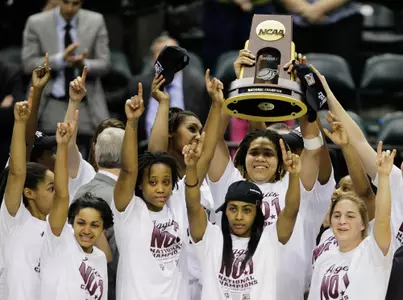
A&M's women's basketball team won the national title in 2011, and the women's track and field team has won four national titles since 2009. Soccer reached the Final Four in 2014; softball got to the national title game in 2008; tennis advanced to the national final in 2013; and swimming finished third in the NCAA meet in 2018.


The women's equestrian team, which is not an NCAA-sponsored sport, won its 12th national title in 2017.
"When I first got here, we were still talking about 1939 [when the A&M football team last won the national championship] and a couple of softball championships in the '80s," said women's basketball coach Gary Blair, who is in his 16th season at A&M. "Now, we have all these championships in all these sports.
"You look at some of these other schools, and they're good in three or four sports. A&M is good in every sport. It's pretty special."

A&M offered some women's sports in the early 1970s, but it wasn't until June 15, 1974, that the athletics department began oversight. Women joined the school's Corps of Cadets that same year.
Vicki Brown-Sobecki became the first female student-athlete awarded a scholarship through the A&M Athletic Department. She also was the school's first female All-American, the first female swimmer inducted into A&M's Athletic Hall of Fame and the first female president of the A&M Letterman's Association Board of Directors.
"A&M offered a scholarship, but there weren't many amenities," Brown-Sobecki said. "Did we think about being the first? No, I don't think any of us really thought about that other than we wanted to compete for the university and do well in school. I will say that most of the women, if you look at statistics if they even kept them, we made sure we were eligible academically, so we could compete at the national level.
"There wasn't a dean of women. There wasn't anybody to help us from the academic side. But we knew if we did not succeed, then it would not help anybody coming behind us because it would be, 'See, told you,' that kind of attitude."
Brown-Sobecki recounts cleaning Kyle Field after football games to raise travel money for the swim team. In its financial report to the NCAA for the 2017 fiscal year, the A&M Athletic Department reported nearly $212 million in operating revenue. That ranked second in the nation to the University of Texas.
In her final season as the A&M women's golf coach in 1992, Kitty Holley still sewed players' uniforms because money wasn't in the budget for them. Today, the women's golf team has a deal with Adidas that outfits them with eight tops and six skorts for competition as well as practice and travel gear.
"It's amazing how far we've come, and it was not that long ago," Brown-Sobecki said.
After becoming part of A&M, women's athletics struggled to find its place at A&M.
The Aggie soccer team played at a local middle school when it became a sponsored sport in 1993, a year before Ellis Field opened. A&M turned break rooms and conference rooms into offices for the coaches of women's sports, and the women's basketball team couldn't convince the Aggie Band to play at its home games.
The school committed little money to women's athletics and paid coaches of women's sports low wages. The Aggie women's sports teams took long van trips, played in front of sparse home crowds and struggled to win conference titles. They were referred to as "Lady" Aggies.
Only the softball team, with an Association of Intercollegiate Athletics for Women national title in 1982 and NCAA titles in 1983 and '87, consistently competed for national titles.
"That was just the time," said Shawn Andaya-Pulliam, who pitched the A&M softball team to the national title in 1987 and finished her career with a 114-28 record, an 0.43 earned run average and 1,234 strikeouts. "Women's sports had to fight hard for a long time to get where they are now. But I also think the more adversity put in front of you, the harder you work for things, so I don't know if I would change a single thing about it."

In 1984, A&M hired Lynn Hickey for $40,000 a year to become the women's basketball coach and an assistant athletic director. Hickey didn't see the spartan locker room until after she accepted the job, perhaps by design. She walked in to find lockers tipped over and a curtain separating the shower from the dressing room ripped down.

"I was like, 'My God, what have I done?'" said Hickey, now the interim athletic director at Eastern Washington. "I had no idea what I was stepping into. The program was not in good shape. [The women's basketball team] had not won for five years, and it was a big challenge to try to step in and build it. It took longer than I thought. There were just a lot of things not in place there at that time.
"But everybody cared, and they knew they needed to make a commitment."
Things have changed in many ways and for many reasons.
Title IX, the school's move to the SEC, a generous alumni base of 469,722 and a commitment to winning all contributed to A&M becoming a model women's athletics program.
"It's pretty remarkable the progress that's been made," said G Guerrieri, the only soccer coach in the 25-plus year history of the program. "In the early days when we were busing everywhere, and we played most of our games in and around the state of Texas, to now being in the SEC and being able to treat our players the way that they're treated is fantastic. The uptick of what the SEC has done for us now has made it to where our women are getting more than they've ever gotten. It's been great. It comes as a nice reward."

While the A&M softball team officially christened its new facility in February, the men's and women's $40 million outdoor track complex is scheduled to open in about a month.

Most teams now have their own practice facilities, their own weight rooms and their own state-of-the-art locker rooms. The women's teams that compete in NCAA sports charter planes for most road games, and they play their home games at some of the best facilities in front of some of the biggest crowds in the nation in their respective sports.
Every team has a sports performance coach, a nutritionist, an athletic trainer, a sports information director and a scholastic supervisor. Team doctors, psychologists and psychiatrists also are available as needed.
A&M's women's athletics program now has an impressive display of trophies for its trophy case and banners for its rafters, but it continues to strive for bigger, better and more.
When Bill Byrne was hired as athletic director in 2003, A&M had never finished higher than 24th in the Learfield Sports Directors Cup, which recognizes the nation's top overall athletics programs. Byrne remembers a retreat for the school's head coaches and senior staff during his first summer at the school when he unveiled the "Building Championships" slogan.
"There were some issues as far as expectations," Byrne said. "I asked everybody to talk about what was best about what was going on here. You heard the usual clichés: Texas A&M is a great university; we have great traditions; it's a wonderful campus; the weather is great. About halfway around the room, I stopped them. I said, 'You understand that not one of you has talked about winning?' They said, 'Well, that's just a given.' I said, 'No. No, it's not. Saying you're going to win requires a lot of risk. You come out and say you're going to win conference championships and national championships is risky. I haven't heard a single one of you talk about that.'
"We changed the conversation, because if you don't set those expectations, you're never going to get there."
A&M is there. It has finished in the top 18 of the Learfield Directors Cup for 12 consecutive years, including five times in the top 10.
Since joining the SEC, the Aggies consistently have placed second among SEC teams in the Learfield Sports Directors Cup standings behind only the University of Florida.
"I'm proud to say that I work at a university that embraces a standard of excellence," said Scott Woodward, who was hired as A&M's athletic director in January 2016. "It's uncommon, and we're uncompromising in our commitment to that."
While winning three national championships in the 1980s, the Aggies played their home games at two city parks. That required Brock to erect temporary plastic fencing in the outfield since women's fastpitch softball fields use different dimensions.
"They were pretty nice city parks and everything, but Lord and behold, I never thought they'd get something as nice as what they're opening there right now," said Brock, who has announced his retirement after 16 seasons at Sam Houston State. "I'm happy for them. It was a longtime waiting."
The A&M softball team finally got its own stadium on campus in 1994 after playing at city parks and intramural fields. But having a stadium the Aggies could call their own was the only thing special about Aggie Softball Complex.
Davis Diamond is in a different neighborhood, an upgrade on the Aggies' starter home with club-level seating, two luxury suites, a spacious locker room, a video room and a full training room. It also houses a 6,744-square-foot indoor hitting facility.
"I never imagined this," said Jo Evans, who replaced Brock as A&M's softball coach in 1996. "We've come so far. You think about our sport, and for a long time, it was an afterthought, or we have to do this because of Title IX or whatever it may be.
"It's completely changed from when I played at city parks just like our early Aggie teams did. Now to move into Davis Diamond, it's great progress. I'm thankful to be at a university that values our female student-athletes."
The Aggies have come a long way, baby.
A&M had an enrollment of 68,603 for the 2017-18 academic year, 47.27 percent of whom are women.
It was not so long ago that A&M was an all-male military school, first admitting women as students in 1963. Since then, women have set many firsts at A&M, and the women's athletics program has won many firsts.
Seven of the eight women's teams that compete in NCAA sports have won conference titles since A&M moved to the Southeastern Conference in the fall of 2012. In five-plus years in the SEC, A&M's women's sports teams have combined for 14 regular-season or conference tournament championships.
A&M's women's basketball team won the national title in 2011, and the women's track and field team has won four national titles since 2009. Soccer reached the Final Four in 2014; softball got to the national title game in 2008; tennis advanced to the national final in 2013; and swimming finished third in the NCAA meet in 2018.
The women's equestrian team, which is not an NCAA-sponsored sport, won its 12th national title in 2017.
"When I first got here, we were still talking about 1939 [when the A&M football team last won the national championship] and a couple of softball championships in the '80s," said women's basketball coach Gary Blair, who is in his 16th season at A&M. "Now, we have all these championships in all these sports.
"You look at some of these other schools, and they're good in three or four sports. A&M is good in every sport. It's pretty special."
A&M offered some women's sports in the early 1970s, but it wasn't until June 15, 1974, that the athletics department began oversight. Women joined the school's Corps of Cadets that same year.
Vicki Brown-Sobecki became the first female student-athlete awarded a scholarship through the A&M Athletic Department. She also was the school's first female All-American, the first female swimmer inducted into A&M's Athletic Hall of Fame and the first female president of the A&M Letterman's Association Board of Directors.
"A&M offered a scholarship, but there weren't many amenities," Brown-Sobecki said. "Did we think about being the first? No, I don't think any of us really thought about that other than we wanted to compete for the university and do well in school. I will say that most of the women, if you look at statistics if they even kept them, we made sure we were eligible academically, so we could compete at the national level.
"There wasn't a dean of women. There wasn't anybody to help us from the academic side. But we knew if we did not succeed, then it would not help anybody coming behind us because it would be, 'See, told you,' that kind of attitude."
Brown-Sobecki recounts cleaning Kyle Field after football games to raise travel money for the swim team. In its financial report to the NCAA for the 2017 fiscal year, the A&M Athletic Department reported nearly $212 million in operating revenue. That ranked second in the nation to the University of Texas.
In her final season as the A&M women's golf coach in 1992, Kitty Holley still sewed players' uniforms because money wasn't in the budget for them. Today, the women's golf team has a deal with Adidas that outfits them with eight tops and six skorts for competition as well as practice and travel gear.
"It's amazing how far we've come, and it was not that long ago," Brown-Sobecki said.
After becoming part of A&M, women's athletics struggled to find its place at A&M.
The Aggie soccer team played at a local middle school when it became a sponsored sport in 1993, a year before Ellis Field opened. A&M turned break rooms and conference rooms into offices for the coaches of women's sports, and the women's basketball team couldn't convince the Aggie Band to play at its home games.
The school committed little money to women's athletics and paid coaches of women's sports low wages. The Aggie women's sports teams took long van trips, played in front of sparse home crowds and struggled to win conference titles. They were referred to as "Lady" Aggies.
Only the softball team, with an Association of Intercollegiate Athletics for Women national title in 1982 and NCAA titles in 1983 and '87, consistently competed for national titles.
"That was just the time," said Shawn Andaya-Pulliam, who pitched the A&M softball team to the national title in 1987 and finished her career with a 114-28 record, an 0.43 earned run average and 1,234 strikeouts. "Women's sports had to fight hard for a long time to get where they are now. But I also think the more adversity put in front of you, the harder you work for things, so I don't know if I would change a single thing about it."
In 1984, A&M hired Lynn Hickey for $40,000 a year to become the women's basketball coach and an assistant athletic director. Hickey didn't see the spartan locker room until after she accepted the job, perhaps by design. She walked in to find lockers tipped over and a curtain separating the shower from the dressing room ripped down.
"I was like, 'My God, what have I done?'" said Hickey, now the interim athletic director at Eastern Washington. "I had no idea what I was stepping into. The program was not in good shape. [The women's basketball team] had not won for five years, and it was a big challenge to try to step in and build it. It took longer than I thought. There were just a lot of things not in place there at that time.
"But everybody cared, and they knew they needed to make a commitment."
Things have changed in many ways and for many reasons.
Title IX, the school's move to the SEC, a generous alumni base of 469,722 and a commitment to winning all contributed to A&M becoming a model women's athletics program.
"It's pretty remarkable the progress that's been made," said G Guerrieri, the only soccer coach in the 25-plus year history of the program. "In the early days when we were busing everywhere, and we played most of our games in and around the state of Texas, to now being in the SEC and being able to treat our players the way that they're treated is fantastic. The uptick of what the SEC has done for us now has made it to where our women are getting more than they've ever gotten. It's been great. It comes as a nice reward."
While the A&M softball team officially christened its new facility in February, the men's and women's $40 million outdoor track complex is scheduled to open in about a month.
Most teams now have their own practice facilities, their own weight rooms and their own state-of-the-art locker rooms. The women's teams that compete in NCAA sports charter planes for most road games, and they play their home games at some of the best facilities in front of some of the biggest crowds in the nation in their respective sports.
Every team has a sports performance coach, a nutritionist, an athletic trainer, a sports information director and a scholastic supervisor. Team doctors, psychologists and psychiatrists also are available as needed.
A&M's women's athletics program now has an impressive display of trophies for its trophy case and banners for its rafters, but it continues to strive for bigger, better and more.
When Bill Byrne was hired as athletic director in 2003, A&M had never finished higher than 24th in the Learfield Sports Directors Cup, which recognizes the nation's top overall athletics programs. Byrne remembers a retreat for the school's head coaches and senior staff during his first summer at the school when he unveiled the "Building Championships" slogan.
"There were some issues as far as expectations," Byrne said. "I asked everybody to talk about what was best about what was going on here. You heard the usual clichés: Texas A&M is a great university; we have great traditions; it's a wonderful campus; the weather is great. About halfway around the room, I stopped them. I said, 'You understand that not one of you has talked about winning?' They said, 'Well, that's just a given.' I said, 'No. No, it's not. Saying you're going to win requires a lot of risk. You come out and say you're going to win conference championships and national championships is risky. I haven't heard a single one of you talk about that.'
"We changed the conversation, because if you don't set those expectations, you're never going to get there."
A&M is there. It has finished in the top 18 of the Learfield Directors Cup for 12 consecutive years, including five times in the top 10.
Since joining the SEC, the Aggies consistently have placed second among SEC teams in the Learfield Sports Directors Cup standings behind only the University of Florida.
"I'm proud to say that I work at a university that embraces a standard of excellence," said Scott Woodward, who was hired as A&M's athletic director in January 2016. "It's uncommon, and we're uncompromising in our commitment to that."

Thursday, April 09
Saturday, October 11
Saturday, October 04
Saturday, September 27