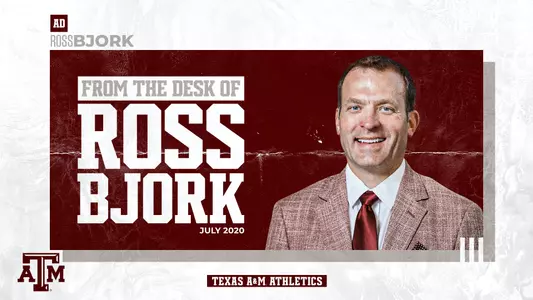
July AD Yell: Ross Bjork
Jul 08, 2020 | General
Howdy!
Greetings from Texas A&M Athletics. While many of our summer plans may have been changed due to the pandemic, I hope everyone has found time to unplug from our "different" routine and re-charge.
As we have experienced over the past five months, our daily routines and any sense of normalcy remains a fluid situation. We continue to make plans and discussions are on-going with regard to college athletics this fall. We remain confident in our planning and we are doing everything we can to make our environment as safe as possible for everyone involved. You can help and do your part to take precautions to slow the spread of Covid-19, especially by wearing a face covering when you are out in public.
As we continue preparing for what lies ahead for our University and student-athletes, I'm honored to work with you side by side as part of the Aggie Family. When my family and I arrived a year ago, we immediately recognized that Texas A&M is truly a special place. "There is indeed a Spirit that can ne'er be told." Thanks to all of you for being the true Spirit of Aggieland.
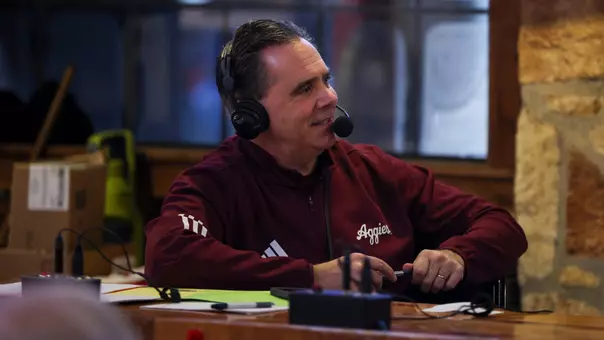
Instead of a normal letter for the July edition of AD Yell, we decided to go "virtual" and sit down with Andrew Monaco, "Voice of the Aggies", to have a conversation and discuss my first year as Director of Athletics at Texas A&M. Please click on the link below, and enjoy the rest of your summer.
Thanks for your support of Texas A&M Athletics! Gig 'Em!
Ross
🔊 Click here to listen/subscribe.
Ross, it has been one year that you have been here in Aggieland. Howdy. Welcome. Thrilled that you're here.
- Howdy, Andrew. It's good to see you in person. We're socially distanced, obviously we're doing this as a podcast, but we are across the room from each other. We're not breathing on each other. We're all good. We won't even shake hands this time.
I have the mask just in case.
- We've got our masks, but we don't have it on because we don't want to be muffled. But we're being safe. But no, Howdy to everyone out there. So great to be with you.
A year ago, you were announced. You were here at Texas A&M, we were in the Ford Hall of Champions, and you spoke with us. Tell me about that day of being announced, you being here. I'm going to rewind it a little bit after that, but tell me about that day that you were announced and you were here.
- Well, I was actually looking at some pictures the other day because it was Father's Day and I'm very proud of my two boys--even though they drive us crazy sometimes, especially since we've been in quarantine--so I was looking for some cool pictures to tweet out about being a proud dad of these two young boys. I was looking at that time and I'm going, 'Wow, time goes by so fast', because it just feels like yesterday that it was a Thursday night and the news comes out that we'll be the Athletic Director, we're coming to Texas A&M.
It didn't really come out the way we wanted it to. We were going to do a press release the next day but hey, word leaked out. And so we put out a press statement that Thursday night, and it was just like the phone's blowing up. And then fast forward about 10 days later and we have the press conference. So it just seems like it was yesterday, but it's been a whole year of memories. Great interaction with Aggies near and far. Our student-athletes, getting to know them. Getting to know our coaches and our staff.
But that day in particular, that visit, I just remember walking away from here, going okay, you know what? I've seen it from afar, and I've been to games as the visiting team, but now seeing it from a different perspective--sort of on the inside--I walked away and we got on the plane going back and I looked at Sonya and she's like, 'What do you think?' And I go, 'We're going to kill it here. We're going to take this program to where it should be, where it's gone in some spots, but where it should be across the board. There is so much upside, I can feel it. And I can't wait to really get started to soak it all in even more'.
And like I said, we can kill it here. We're going to kill it here. I wish we would have been up and running the full year and we didn't have this pandemic. But I know what this place is capable of. And I know the type of leadership that I can hopefully provide. I believe that's where we can really get it to that next level that Aggies expect.
Did you feel the same embrace from Aggie fans when you got here?
- I did. And I want to take that 'we're gonna kill it here' comment and make sure that people realize, look, I'm a very humble person. I think people that have met me realize that. But also you have to be confident in your abilities. And so you channel that.
But interacting with people, to that question about did you feel that embrace from Aggies? Yes. I really felt it probably from the first day on the job which I went over to our swimming and diving practice.
They were practicing on my first day on the job and I walk in there and the student-athletes were like, 'So you're the AD'. 'Yes, that's why I'm wearing a shirt and tie on July 8th, when it's 110 degrees. Because I'm the AD.' And they're like, 'Hey, what are you doing at practice?' And I'm like, 'Well, I'm here because of student-athletes. I'm here to serve you. I thought the first official act would be really cool to do something around student-athletes, and you're the only ones practicing on July 8th at seven in the morning.' But I really felt it from that first interaction, honestly. They felt like, okay, this is going to be a person that's going to invest in us.
And then each interaction that I've had I felt the same thing where people kind of wanted to touch and feel, if you will. Touch and feel the athletic department. Maybe it is the position, maybe it is because it's the Athletic Director position it takes on a different meaning or feeling, but to me it should be about Texas A&M. So I felt this pull of people saying, 'We need this type of leadership. We want interaction. We want enthusiasm. We want someone to cast a vision for the program. And just to be a real person.'
I've had other people come up to me and say, 'Are you really the Athletic Director?' 'I'll give you a business card, I'll show you the website. Yes, it's me. I'm a real person. There's not somebody that sits behind a curtain.' So that's been really exciting, that there's this relationship, because we're so big. One of things I've said is we're so big and that's an advantage. But yet it's still about the relationships. And to me, I've felt that on all sides of every person I've interacted with.
Your relationships deal with the student-athletes. They deal with everybody in athletics, everybody throughout this campus, with donors, and part of fundraising. You have to get up to speed, but you have a knack of remembering who people are. That makes the person you talk with feel pretty special. That also part of that relationship?
- It is. I think when you're always working with people, you want to try to build some connection. Now, I'm not perfect by any means. A lot of times I'm like, 'Can you give me your name again? What was your name again? I remember we met at this function, but I can't exactly remember.' So I'm not perfect by any means. But what I try to do is build some connection with that person in that moment, repeat their name maybe a few times. 'Hey, tell me where you're from.' So the next time I see them, I could say, 'Hey, that's Andrew. Yeah, he lives in College Station. He used to live in San Antonio. Okay, now, now I know exactly what his name is.' Probably more like Buzz Williams. Buzz Williams is the best at it. He is 100 times better than me. But that's what you try to do is you try to make some sort of personal connection in these relationships, and then it hopefully creates a bond. You know, for the long term.
Difficult to leave Ole Miss?
- It was. Probably more on the personal side, because we had a great neighborhood. We knew everybody in every house. We knew all their kids. It was an amazing lifestyle of living there and having great friendships.
On the professional side, we had gone through a lot of transition. I was on my fifth chancellor when I left. They'd just hired a new chancellor in the summer. So there was just a lot of probably instability on the professional side that I'm thinking, you know what? I don't have to leave here. I can work here for a long, long time. But is there something out there that's better?
And A&M just has an 'It' factor to it. The resources it has, it's a place where we want to live, in Texas. I love being in this part of the country. So the personal side with our kids' friends, our friendships that we developed in the community, that's what made it hard. And you invest, right? You invest seven years. You know the coaches, you hired certain coaches. Calling Kermit Davis that Thursday night and telling him, and he had already kind of heard. He's like, 'Ross. I know why you're calling. Hey, I don't blame you.' Calling Yolett McPhee-McCuin, the women's basketball coach, because we had just hired her. Calling Matt Luke, who we had been through a lot of battles with just to get to a stable place, calling him and saying, 'Hey, I've got to do this.' Calling Archie Manning. That's hard, right?
So it's more about the personal side of it. My neighbor comes banging on the door at like 9:00 on that Thursday night going, 'Is this true? Is this true?' And I'm sitting there going, 'Yeah, I'm on the phone a million people right now and yeah, it's true.' That's the hard part. The professional part, it just made a lot of sense. The timing was I thought was perfect in a lot of ways, and so it's more the personal side.
You weren't looking. A&M came to you. That has to be a quite a boost for you to know you're not working in a void. What you're doing matters. That's not always the case. But you don't know Scott's going to leave for LSU, right? You have no idea that's going to happen. It does. Then R.C. Slocum takes the interim. Mr. Aggie as I call him. But they come after you. That had to be quite the boost.
- It was. It was kind of funny. I've told this story before, but the week R.C. was named, whatever the timing was...I know was on a Monday and we're having A.D. meetings the following week. And this was right before R.C.'s son became ill when he had the accident and became ill. I called R.C. on that Monday, and I'd met R.C. kind of coming and going at a few National Football Foundation events...and I called him and said, 'R.C. next week we have AD meetings, you're a new AD, if you need anything ahead of the meeting as you get the materials, give me a call. We're here to help. SEC, one of things about ADs is we're all family. We're all competitors, but we all share information. If you need anything, let me know.' Well, he couldn't come to the meeting because of his son's situation. And I made that call having no clue that A&M would be interested, that they'd even call.
About three weeks later, I got a phone call from somebody that Mike Young was working with saying, 'Hey, A&M wants to know if you want to be on their list, they're only going to look at sitting athletic directors. They're going to keep it a small group and they want to know if you'll be on the list.' And I'm like, 'How do you say no to that? What's the process? Who's involved? Is it confidential?' You think through all those things. My son was actually in the car, and he's like, 'Dad, is that like the Texas A&M?' 'Yes. There's other Texas A&M's, but there's only one Texas A&M Aggies.' So we had a laugh about that because he was like, 'Dad, you gotta take that job.' I'm like, 'Well, first of all, it's just a phone call. Doesn't mean anything. I don't know what's gonna happen.'
And then I didn't hear anything for a couple weeks and you just kind of go about your business. And then a few weeks later, I did get a call from President Young, asking if we could meet face to face. So we did that. And then it came together fast. And so I guess what it does is lets you know that A&M wanted somebody who really understood the SEC. Obviously seven years as an AD, I understood the league. The relationships are easy to just continue. So I think that was a key part of it. And then I can't control my reputation. I can only control what I do and how I live, and the integrity that I instill among our programs. And so I guess all those things mattered. I had a great meeting with Mike Young, and we really clicked and hit it off. Here we are a year later, and it goes by fast.
Well, it has been fast, and I'd like it to be a long association. Would you like to be here for a long time?
- I'm in my late forties, I'll be 48 in October. And, you know, these jobs are challenging. How long do you go? That's all dependent on lots of factors. But I told Sonya, we've moved a lot since her and I got married back in 2002. And I told her, this needs to be and should be and can be the last move. There is no reason...where else would you go?
I mean, really, when you think about it. We're top five in a lot of areas, room to grow in others. The University, largest student body in the in the country. Living in Texas has so many advantages for our children, where they can grow up in the state of Texas and have an unlimited opportunity once they're going to college and graduate high school and start families or whatever they decide to do with their lives. So there's so many opportunities.
How long does that last? 10, 15, 20 years? I don't really want to work until I'm 70, by any means. I want to enjoy some life in retirement years, so let's just crank it out. Let's work as long as possible as hard as possible. That will be the goal. This is the last job. That's how we view this.
I knew it would have to be a special job for you because of you selling the Deputy AD job to Michael Thompson, to get him here, I knew it had to be special if you were going to grab him and align with him once again.
- Well, I called him whenever that was, September or October, and I kind of used the same comment I made when I was leaving the press conference here. Michael, you can come here and you can knock it out of the park. There are so many opportunities and so many resources. For no fault of anybody, but just the external peace was a little bit fragmented.
I thought if we could really bring everything in unison that we could really get our business principles in line and our external relations and all the technology and the social media, and we've still got work to do. Obviously with the shutdown, we've had to pivot a little bit. But I told Michael, this is a gold mine for the stuff that he likes to do and he's really good at. This is a gold mine. Let's come here, and I need you here. I need somebody with your type of vision.
He's been a great fit, as one example of the team that we've put together. Justin Moore has been terrific. We hired Kristen Brown as our Deputy Athletics Director/Senior Women's Administrator. She got here on March 25th and immediately got locked in her apartment, unfortunately, so we haven't really been able to see her a whole lot. But when she gets fully ingrained and up and running, she's going to be a great asset for our program as our really our chief leader on the female women's athletic side. But also just a confidant to me as a deputy athletic director, somebody that I can lean on and really trust, and so she'll be a great addition. Justin Moore. Michael. We mentioned them. The whole team. Jeff Toole. Jonathan Bowling. Kevin Hurley. Mike Wright. You, Andrew. Andy Richardson. Everybody. I could go on and on about all the great people in this athletic program that are in it for the right reasons.
As you're looking at this job, you're seeing the coaches that have been hired. You inherit those. There is a ton of talent here at A&M. Does that help your decision?
- It really does. You know, a lot of times when you get hired as a new AD, you have to come in and fix football or basketball or something like that. And so part of the attraction for me was that stability. Oh, wow, we have long-term relationships with Jimbo Fisher and Buzz Williams? Those resources are there. They're locked in. Let me come in and help them figure out what's needed. What else is needed? How do we take it to that next level? But knowing that there's stability there, that was a big part of it.
When you're a Deputy AD, when you're a senior associate AD, when you're kind of rising in the ranks, you can't wait to do a coaching search. When you're an AD? The last thing you want to do is a coaching search. I don't want to do a coaching search. Let's have stability and success where we have the right people in place.
Now, there's going to come a day where we'll have to do a coaching search here at A&M. It's going to happen. But that was really a great part of it. I saw what they were doing in women's volleyball with Bird, and we had to kind of keep her. We had some people come after her after the season she had. So that was really attractive to me, the stability piece of it.
Even the long-time coaches here, though. They're not just putting in time. They have stamped their programs with excellence, right? They keep striving for that. You talk about fit...they fit A&M. You now fit. So it's almost like the puzzle pieces get to go together.
- Right. Well, you look at Coach G. The consistency that he's had, and we've got some facilities we need to address in that program. But again, there's kind of that next level. How do we get to that next level? That consistency. Pat Henry and all the national championships. Gary Blair being a national championship head coach. Coach Higgins in men's golf. A new coach like Andrea Gaston in women's golf.
Boy, we have some big-time coaches. Our job is to support them. What do they need? And then we just get out of the way and let them do their thing and be successful. So that's really fun to see that stability and that success.
You've embraced more than just the Athletics Department, you've embraced the entire University. It's something that I really noticed with Jimbo when he came. It wasn't just his football players and his team. In fact, to that point, you talked about the Corps and you raved about the core values back on your very first day, didn't you?
- I think that's what you have to do. I really believe that we cannot be isolated or separated from the rest of the University. We need to be a part of it. We need to be ingrained. They need to know that we care, because what do we expect of them? We expect them to come to games, support athletics, be part of the pageantry. If we're not investing in them, then how do we expect them to really ever support us? And so I think it's really a two-way street.
I hope, because we did this last year, that we can deliver Gatorade to the Band in August. That's what we did last year about the middle of August because they do two-a-days. They have two-a-days just like football, and they're out there practicing. It was hot out that day. So I'm hopeful that we can get back to those moments because again it's reaching out. It's showing that we care. And we've done that.
Here's what I've told people the last couple weeks: If we didn't build relationships early on, and then we had to go to a shutdown, and now that we're ramping back up to reopen? I'm not sure that I could have quite the voice or the seat at the table that we do have on campus right now. Where people, they trust us, because we reached out to them before we ever needed anything and said, 'Hey, we're here. This is how we want to operate athletics. Here's our philosophy.' If we didn't do that early on, and we're sitting here trying to build our program back up to reopen, there might be some skeptics out there. There might be people that say, 'Hey, we're not quite sure about the leadership in athletics, because we don't really know him.' We built those early on. So I think that's been important as we've dealt with this whole pandemic.
Did it help that you were out in front of it, from March 11th in Nashville? You're there in the team hotel, the SEC tournament's about to be cancelled. But that wasn't just your focus. You're on the phone because you've got every other team in the spring seasons. You have been out in front of that. That's been on purpose, hasn't it?
- I think so. I think people need confidence. We were talking before we went on the air about well, every day it seems like we have different emotions. Some days we're real confident. Some days, maybe not as confident. The next day, that flips back to being confident. Part of this is keeping people informed so that we remain obviously realistic, and we have to give honest, brutal facts. But we also have to look at how do we get out of this? And if we don't have a road map and we don't have anyone leading that road map or even communicating that road map, it will lead to a lot of uncertainty.
So part of being visible has hopefully tried to lead to some certainty that this is all going to be over at some point in time. We don't exactly know when, there's still a lot of moving parts. But if we stay organized and stay informed, then we know that we can come out of it. That's been the mentality of trying to stay visible, trying to be out in front. And then the last month, man, it's been so busy that we haven't done as many outreaches or interviews. That's why we want to do this kind of in a virtual setting for the month of July.
How proud are you that they had SEC schools calling Texas A&M about how to open when the student-athletes are back? This wasn't done in a vacuum, was it?
- What I've told our staff is that people are going to look to us because we're Texas A&M. We're in the state of Texas. We have a huge, large University. We have lots of resources that we can deploy as we put together those plans. I knew people would look at us. I knew that we needed to be really smart about our plans, but also be out there in terms of, 'Hey, look. This is what we're trying to do. We're trying to be informed and organized, but we also need to move forward and reopen. Therefore, we need a plan.'
And so, yeah, people have come to us. They have looked at how we're doing things. Hopefully we've been able to kind of set a best-practice mentality. That's been neat to have people call... I'd probably talk to maybe one or two ADs a week before all this started. I probably talk to 10 to 15 a week now, because people are checking in there, asking what's going on, asking how we're handling certain things. So that's been a proud moment. But it also allows us to learn too.
That's what I find interesting for fans. It's not really 14 separate ADs. Yes, you have to take care of your school. But in cases like this, this is where you all work together for what is best for the Southeastern Conference or to learn that what is happening at this school may apply to us as well. So it's separate at times, yeah you want to win and you want to be the best. But there's so much togetherness as well.
- And I think especially now. The reopening phases were all sort of dictated by the local governance. Texas was ready maybe quicker than Kentucky was. But especially now that we get into the practice periods and the competition periods, we really need to be on the same page as a conference. That's going to help all of us. Because we don't know if we'll have to pivot, right? We still don't know exactly how this is all going to unfold 100 percent.
But we need our conference membership to stay together and to stay on the same page. We do a bi-weekly conference call. We're actually talking about meeting in person sometime in the month of July. So after this airs, we probably will have a face-to-face meeting with athletic directors. So that cohesion...we were together before, but that cohesion has been invaluable as we've gone through this.
You are a reader. Have your book selections changed since all this happened?
- A little bit. The last probably month or so I've been slacking because I think the volume of activity has picked up. And there's more things happening, especially with the social matters. So I've been a little lazy on the reading. I got to get Buzz to get me motivated because he reads all the time.
I think I've always been storytelling around challenges or leadership moments where people have galvanized around some cause to rally and get better. We had Damon West come talk to us as full athletic staff last month. His book, The Coffee Bean, has been great. I mean, you talk about a simple principle, but so profound. I hadn't read that book. I met Damon last fall when he came and talked to the football team, but I hadn't read his book until he was speaking to our staff. So a lot of leadership books, a lot of lessons on how people have overcome challenges.
One of the books that Coach Williams gave me was Thinking in Bets. Basically how a poker player thinks, because they don't have all the information, but they still have to play a hand. It kind of goes through that process. Because we don't have all the information, right? It was perfect. And so he sent that to me and said, 'Hey, I think this will be applicable to what we're all going through.' And so books like that have been have been terrific.
You brought up the social issues, students finding their voice. I found it heartwarming when I saw the word 'Unity' on our student-athletes, I thought that was the perfect word for that social message, that social time, that march together. Unity was an important word, wasn't it?
- It really was. And I really commend our student-athletes for stepping up and hosting the Unity Walk. That was their word. We didn't tell them to say that. We didn't coach them on anything. When they first sent us the flyer of what they wanted to do on that Thursday night, that's what it said. A Unity Walk. To gravitate towards that word, where we all need to come together in this time.
It's really sad, what's happening. It blows your mind that this is the United States of America. So what is that word? United. Unity. And we're having these conflicts. We know the world's not perfect. We know the world has people that have hate in them, but we should be better than this. And our student-athletes, I believe, have set a great example of how we need to talk about this, how we need to socialize this, how we need to display great leadership in public and not be fighting and burning and things like that. There's a way to have your voice expressed and our athletes have done it in a grand way, and I'm really proud of them.
There's a lot of work to be done, Andrew. There's been a lot of questions about, why now? Because people we care about are hurting, in a deeper way than maybe they have before. So it feels different because of that, because of people that I know personally, they seem to be hurting at a different level. We need to care at a different level. I hope this continues. I hope this journey continues to get better. I believe it will. I think we'll see a lot of things as the academic year unfolds where we're talking about Unity.
There's going to be some challenges. What does Election Day bring? There's going to be a challenge around that conversation. What happens on game day? There's things that are going to be challenges. But we have to remember that word. That we're Aggies. We need to be unified. And we're going to continue that message.
The 'student' in student-athletes...I've told you this before. Tyrel Dodson, our former linebacker, said, 'Look, if I wasn't the student I was, I wouldn't be an athlete. If I wasn't the athlete I was, I couldn't be the student here at Texas A&M.' But the 'student'...and whether it is social, whether it is with the Aggie Network as part of the Aggie family, it's almost like a 360-degree student, isn't it? A little bit of everything. You want that 360- degree student-athlete, don't you?
- What I tell recruits when they come on campus, and I've used this my entire career as an athletic director, is we brought you here for three reasons. One, you're a good person. So we've checked your character. Two, you do well academically. So you've qualified to have this opportunity. And then three, you can play. And really, if you do those three things--if you are a good person, you take care of your academics and you can play--the rest kind of could be pretty simple as long as you stay focused on those three things.
And I think that simple approach can apply. Be good socially, have a voice if that's what you want to do. But hey, let's be good citizens. Let's do well academically. And then, by the way, we're here to play at the highest level. We're in the SEC. We're Texas A&M. There's a reason why we're recruiting you. That applies. So to me, that's that 360 approach.
We had our best academic year on record this past year. We had a 2.977 cumulative grade point average for the fall semester, and we had a 3.1 cumulative spring semester GPA. For the first time ever we have a 3.0 cumulative grade point average for all of our student-athletes for their entire academic career, whether they're a freshman or a senior, that's never happened on record. So we're really proud of what our student-athletes are doing in the classroom. I've always said, typically teams that are pretty good on the field, you look at their GPAs...they're probably pretty good. There's a correlation there. There definitely is. And so we've got to keep going to keep that message going.
I told Joe Fields, why did you do a 3.0 the first year? You're supposed to kind of ease into that. You're supposed to have that happen in like year three or four. So we actually had fun with that. But Joe and his staff, what they do for that holistic approach of our student-athletes is just amazing, especially in this virtual world that we're in right now. And it's been fun to see that. I like the way you put that, the 360 approach to the student-athlete.
I had Joe on the previous Conversations podcast, and he corrected me when I said it was a really good year. He said, best year ever. He was so proud, and that goes back to what you were saying. I keep coming back to the word 'fit'. Here's someone, Joe, who 'fits' his entire staff who deal with the student-athletes. Trust is another big thing, right? That kind of trust that keeps that communication and everything open. My guess is the student-athlete doesn't fear oh, is Ross going to be angry if we have a unity march? They're running it by you, knowing they're going to the right thing because of that fit here. And that's the type of student athlete you want here, don't you?
- That's exactly right. We want everyone to be a leader. That whole saying, 'leaders have to be born'. No, they don't. Leaders emerge. And this is the platform that we're giving. We can allow them to emerge as leaders. Do they need advice. Do they need counsel? Do they need teaching? Absolutely. They're young people. That's what we work with, is young people. But when you have those personal relationships, it creates a rewarding opportunity.
I was having a conversation with a long-term employee here, he'd come from the private sector. And he said, 'I didn't really understand the impact that you could really have on student-athletes because I was a fan before. Now I work here. I wouldn't have another job. It's so impactful on what we can do with student-athletes.' So that that's the cool thing. Joe facilitates all that.
But like I said when we had our press conference, I said, 'Everyone in the athletic department can be an academic advisor'. And what I mean by that is all you have to do is say, 'How was class today? Hey, what have you done? What kind of projects have you worked on lately?' You don't have to look at their class schedule. You don't have to get into all that stuff. It's just, 'Hey, how's class going today? Hey, you look a little stressed. Is everything OK?' 'Yeah, I just had a big math test.' 'Hey, I hope you did well on that. I'm sure you were well-prepared.' That's being an academic counselor. So those kinds of things, those moments, are what I think we thrive in.
There's no one path to get to be a director of athletics. But being an athlete yourself, has that paid off for you now as an AD?
- I think it definitely did early on. It sort of created that path. I was a fullback, so I needed a clear path. There wasn't a whole lot of finesse. But I think it does. I think when you're trying to get in and you're trying to kind of create a reputation, being a student-athlete--being in that locker room--I think you can comprehend things. That was a long time ago and things have evolved.
I have so much respect for the coaching profession. When I can tell them, 'Yeah I understand that, because I was a player and I've been in college athletics for a long time', I think it does help. It has that perspective. It has that filter. The other thing is I try to stay in shape. Not that I can compete with the athletes, but hopefully they see somebody trying to set a positive example. 'Oh, he played college sports. At least he has some connection to what I'm going through.' I think it does help have a have a great perspective.
It was a different era, but you've been connected the entire time. So you've seen the changes, grown with the changes, been a part of those changes, right?
- I remember before the Internet. I remember before social media. I remember 'pre' a lot of things. Our oldest son was born in 2006, it just happened the way it happened, but laying next to his little crib was a BlackBerry phone. For some reason, the phone was just laying in the crib, and we took the picture. Well, when we had our second son, it was 2010 and by that time, the iPhone was out and so I put the iPhone in the crib. So I tweeted that the other day and somebody said, 'Boy, I remember the BlackBerry days'.
So I've been around a little bit. I don't believe I'm that old, right? But I've seen the evolution of all this. Lately, we're seeing student-athletes have a voice that they've never really expressed themselves before, for whatever reason. I've seen that evolve. I've seen television evolve. I've seen the NCAA, as much as we criticize a lot of things that perhaps go on at that level, we've evolved at the NCAA level and created more opportunities for our student-athletes. Facility development...we've heard of the arms race. Well, the arms race really never stopped. We're constantly building things. So seeing all that I think has provided a great perspective for not only learning what we've gone through, but also how we get to that next level.
The social media aspect. You have embraced it, haven't you?
- I think you have to. I think you have to be engaged. I don't tweet back at everyone. I don't respond to everyone. It's not really possible. Probably not really smart, because you can kind of go down some rabbit holes. But I think you have to at least put out messages, showcase the program. Every now and then I'll do some family things like I did on Father's Day. But mainly keep it about work, about promoting Texas A&M, about the things that we're doing, hopefully promoting our student-athletes.
Coach Bird was teasing me the other day because I retweeted a softball video. And like five days earlier, I didn't see the volleyball video because it just got lost in the shuffle. And she was like, 'Hey, you didn't retweet the volleyball video'. 'Okay, Bird, I'll get the volleyball video'. So I had had to go back and catch the volleyball video. So I'm not perfect by any means. You have to have fun with it. You have to have some levity. You have to laugh at yourself. I've done that. So, yeah, you've got embraced social media.
As you look back on your first year. How would you describe it?
- Well, if you take out the last 100 and some days...I go back to March 11th as really kind of the first day of dealing with the pandemic. We had heard about this actually in late January, because we had perhaps a Texas A&M faculty member who might have been exposed but actually wasn't. But that was reported early on and we were hosting a track meet. And so we had to kind of deal with it. But then we kind of forgot about it. Then really March 11, I use that day as the starting point.
So if we take out that period, it's been a great year. I've really tried to learn and get to know this place as much as possible. Get to meet as many people as possible. Be engaged with our student-athletes, because they're the most important. Be engaged with our 12th Man Foundation donors, because we need their support and we're going to keep asking them to support us. Be engaged with our coaches. Be engaged with the community.
In some ways, Andrew, because we've been shut down, I feel like when we do get back up and running, I may have to restart in some areas and that will be okay. Because that's another chance to build even more relationships. 'Hey, I haven't seen you in about five months. We've been shut down. I met you back in October of 2019. Here we are again.' So in some ways, you might have to kind of restart a little bit. But I know that because of the first year that I've had, that we've had here, because of all the things that we've learned, we have a head start.
We can get through this. We will get through it. We're going to be stronger than a lot of other programs because of Texas A&M and the platform that we have. So that's been exciting to kind of see it, from behind the scenes, being involved in it, helping put all the pieces together, putting the right people in the right seats on the bus to move us forward. That's been a lot of fun for all of us.
And I just appreciate the way people have embraced me and our family and our boys and Sonya. It's just a great place to live. We love it. We love College Station. We love Bryan. We love this whole Aggieland area. I love being close to Houston. You can fly anywhere in the world. We just love being in Texas and can't wait to see what the future holds.
I'm going to use one more word with you as I wrap this up. Genuine. Aggies are genuine. But Aggies also know genuine people. You are too, my friend.
- I appreciate that. You've got to be that way. I learned that from my parents growing up in Dodge City, Kansas. You've got to be genuine in Dodge City, now. But it's been great, Andrew. I appreciate getting to know you. And thanks for all that you do for the program.
Absolutely. Ross Bjork, Thank you very much.
- Thank you.